
Gaza Ceasefire, revisited
How is the Peace Deal Holding?
April 30, 2026
On 10 October 2025, a ceasefire took effect in Gaza, ending the 2-year war.
A temporary Yellow Line of Israeli withdrawal is becoming a permanent border.
Peace Plan’s phase 2 has not started as Hamas refuses to disarm, and Israeli strikes continue.
Over 750 Palestinians have been killed since the ceasefire began.
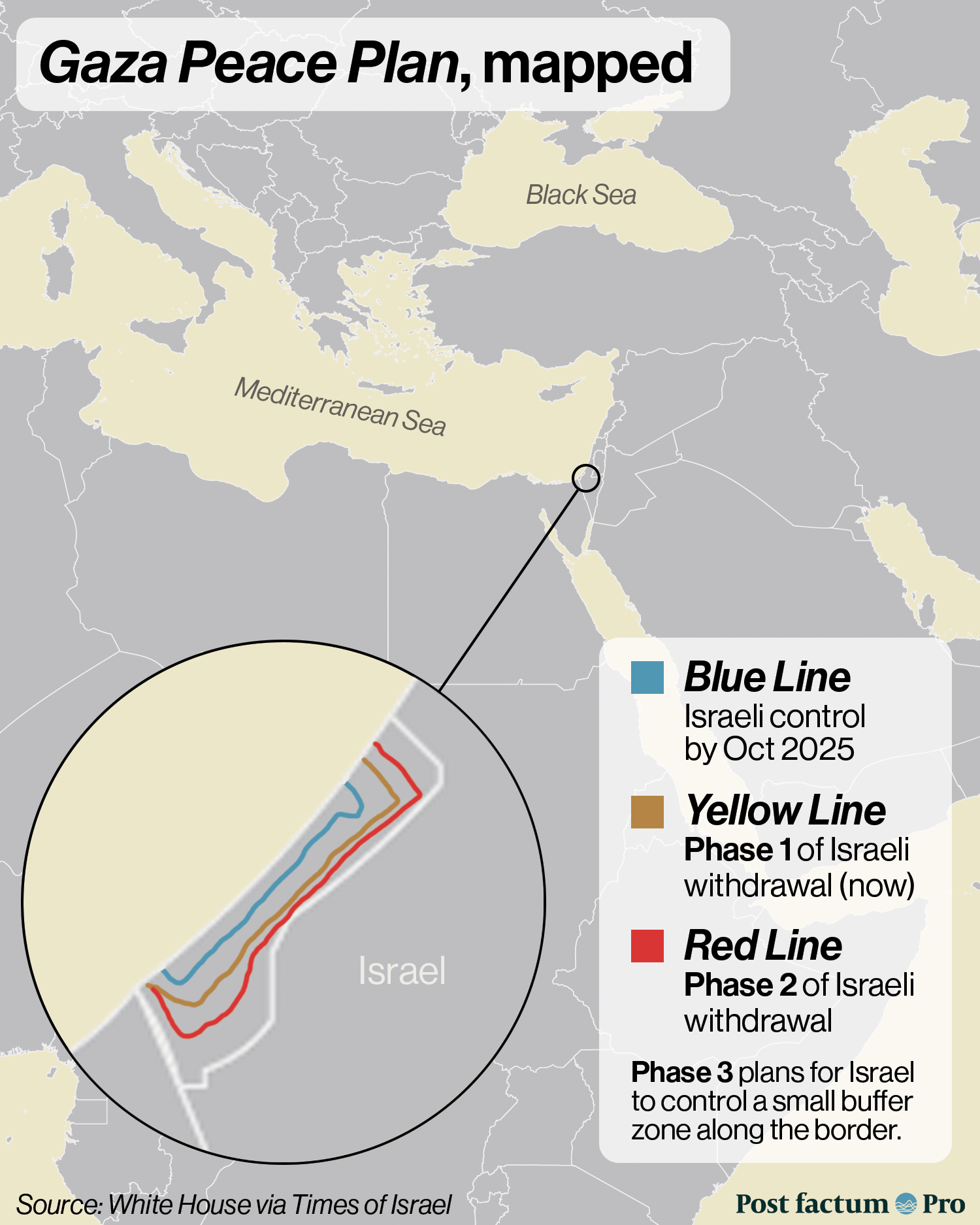
The Gaza Peace Plan has 3 phases:
Phase 1: Hamas releases all hostages and gives the bodies of dead hostages to Israel; Israel withdraws to a ceasefire line (the Yellow Line); humanitarian aid resumes.
Phase 2: An international military force deploys in Gaza; Hamas disarms and Israel withdraws further, to the Red Line; the Board of Peace oversees governance (more below).
Phase 3: Full Israeli withdrawal except for a buffer zone along the inside of the border. The Palestinian Authority later takes over.
Current status: Phase 1 has been partially implemented.
All hostages have been returned and Israel withdrew to the Yellow Line, but aid remains restricted, and Israeli strikes have not stopped.
The ceasefire agreement planned for 600 aid trucks to enter daily. Currently, fewer than 200 trucks are entering Gaza per day.
The New Border
The Yellow Line is a temporary line of withdrawal of Israeli troops in Gaza.
It splits the Gaza Strip in two, with 53% under Israeli military control.
The side controlled by Israel includes all border crossings.
Israel has pushed the effective Yellow Line deeper into Gaza, now controlling 58% of the Strip.
It is also building barriers and military outposts along the line.
Israel now controls the largest share of Gaza since it ended its occupation in 2005.
In January 2026, US envoy Steve Witkoff announced the start of Phase 2.
However, it has not actually begun in practice.
An international force of up to 20,000 troops could be deployed to Gaza under the peace deal. Trump claimed that no US soldier will be sent.
So far, no international force has been deployed inside Gaza.
Phase 3 leaves Israel with a 1 km-wide security buffer along Gaza’s border.
The buffer includes the Philadelphi Corridor, a 14-km strip along the Egyptian border that Israel describes as a smuggling route.
The Disarmament
The peace plan makes Hamas' disarmament a condition for Israeli withdrawal. Both sides refuse to move first.
Hamas' position: no disarmament before a full Israeli withdrawal, the reopening of all crossings, and the start of the reconstruction.
Israeli position: no further withdrawal until Hamas fully disarms.
A poll found that 69% of Palestinians oppose Hamas disarmament (87% in the West Bank, 55% in Gaza).
Power in Gaza
Under the peace plan, Gaza is to be governed by a technocratic committee of 15 Palestinians, replacing Hamas in civil administration.
A technocrat is a scientist, an engineer or a technical expert who holds a position of political power, or acts as a political advisor.
This committee's mandate covers public services, finance, health, water and reconstruction.
It is operating from Egypt because Israel has blocked its members from entering the Strip.
So far, the committee has not delivered any public services inside Gaza, nor taken control of any ministry or municipality.
Since the beginning of the ceasefire, Hamas has regained control of most of the area west of the Yellow Line.
According to a poll, 41% of Gazans support Hamas, while 29% support the Fatah.
Fatah is the largest Palestinian party; it controls the Palestinian Authority (PA), which governs in the West Bank. Since losing the 2006 elections in Gaza, it has been Hamas' main political rival.
Hamas currently controls policing, taxation, aid distribution, and pays salaries to public officials.
It has also rebuilt its military wing to around 27,000 fighters.
Hamas has killed the members of several clans that challenged its authority, including the leader of the Popular Forces, an Israeli-backed group.
Amnesty was offered to clans that surrendered their weapons.
In April, the PA organised the first (municipal) elections in Gaza since Hamas took power in 2006.
The list backed by Fatah won 6 of the 15 seats. A Hamas-aligned group secured 2 seats.
Hamas itself did not officially present any candidate. 23% of eligible voters took part.
The elections were a “test”, intended to link Gaza and the West Bank politically.
Only 33% of Palestinians (across both territories) support full or shared PA governance of Gaza.
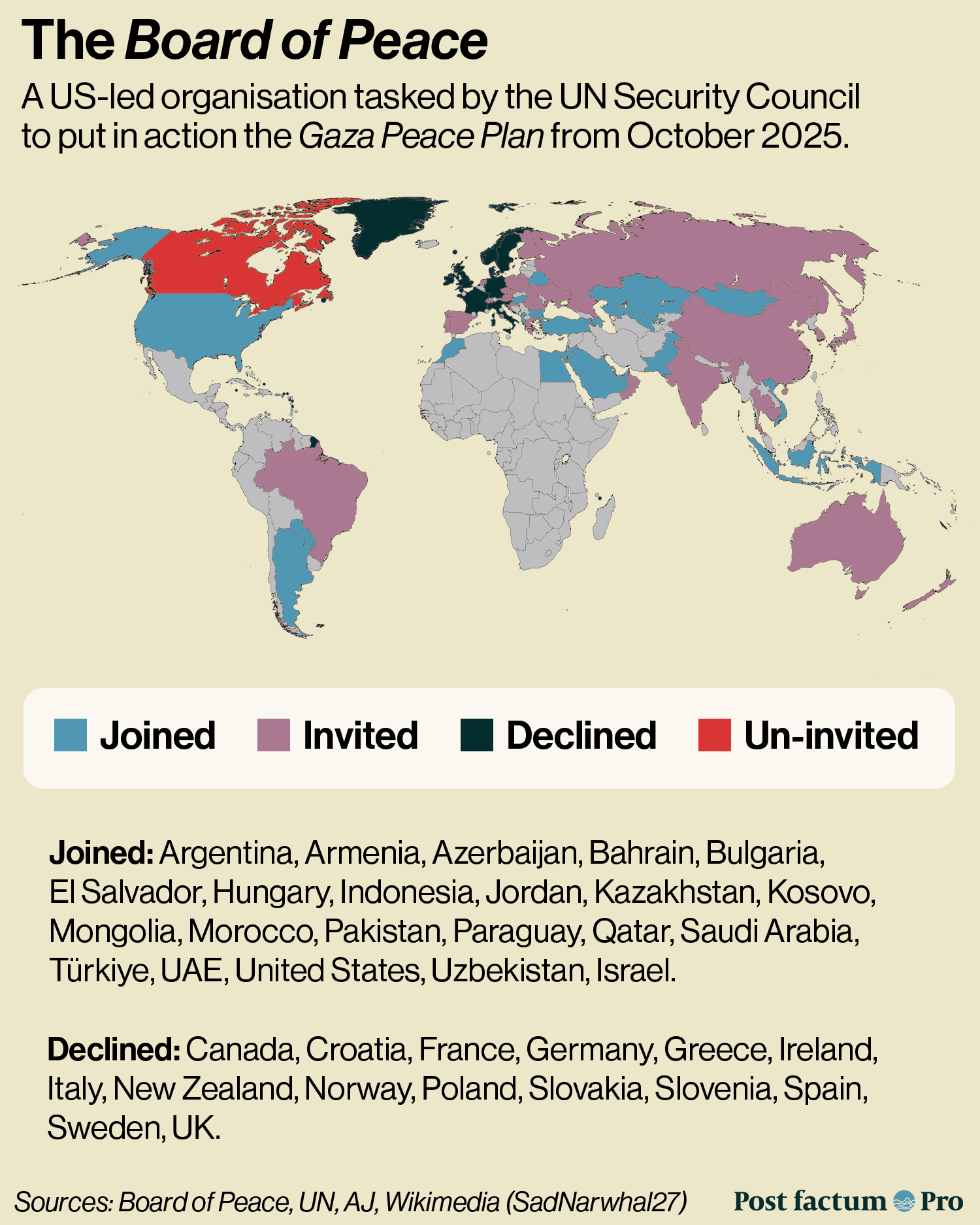
The Board of Peace
The Board of Peace (BoP), created in January 2026, is the body in charge of overseeing Gaza's reconstruction and political transition until a reformed PA can take over.
The plan requires the PA to carry out reforms, including fighting corruption and ending payments to families of imprisoned militants, before it can be allowed to govern Gaza.
Donald Trump is the Chairman of the Board for life, regardless of his role as President of the US.
Membership requires a personal invitation from him, and a $1 billion fee.
United Nations Security Council's mandate to the BoP expires in December 2027 if not extended, and the BoP may dissolve or become a private organisation after that.
The BoP has 27 founding members.
More than 60 countries were invited but most refused to join. Among the EU, only Hungary and Bulgaria joined.
In February 2026, BoP members promised $17 billion for the reconstruction of the Gaza Strip.
The reconstruction cost is estimated at over $71 billion. No large-scale reconstruction has started.
There are 3 main proposals:
The US-led New Gaza: a 10-year plan to rebuild Gaza as a tourist and business hub, with luxury resorts and skyscrapers. Gaza's inhabitants would be temporarily moved out during reconstruction, and offered financial incentives.
Egypt's plan: endorsed by the Arab League, proposes a $53 billion reconstruction of Gaza and its infrastructure, and to hand it over to the Palestinian Authority eventually.
The Palestinian-led Phoenix Plan: a 5-year plan that rebuilds existing neighbourhoods rather than replacing them, and that recycles war rubble into construction materials. It is the only plan with direct input from the Gazans.
Continued Violence
Since the ceasefire took place, at least 738 Palestinians and 5 Israeli soldiers have been killed in Gaza.
Both sides accuse the other of breaking the ceasefire.
The Gaza Government Media Office has documented over 2,400 Israeli violations, including over 1,100 strikes and 273 demolitions of property.
The Israeli army carries out near-daily strikes against what it identifies as Hamas operatives planning attacks on its troops.
Most strikes happen near the Yellow Line or in the city of Rafah.
On 28 February 2026, Israel closed all Gaza crossings after the start of the US-Israeli war with Iran.
The crossings partially reopened after the 8 April US-Iran ceasefire.
Author Simone Chiusa
Editor Anton Kutuzov