
Geopolitics of FIGHTER JETS
US vs China, Race to Gen 6, and more
December 28, 2025
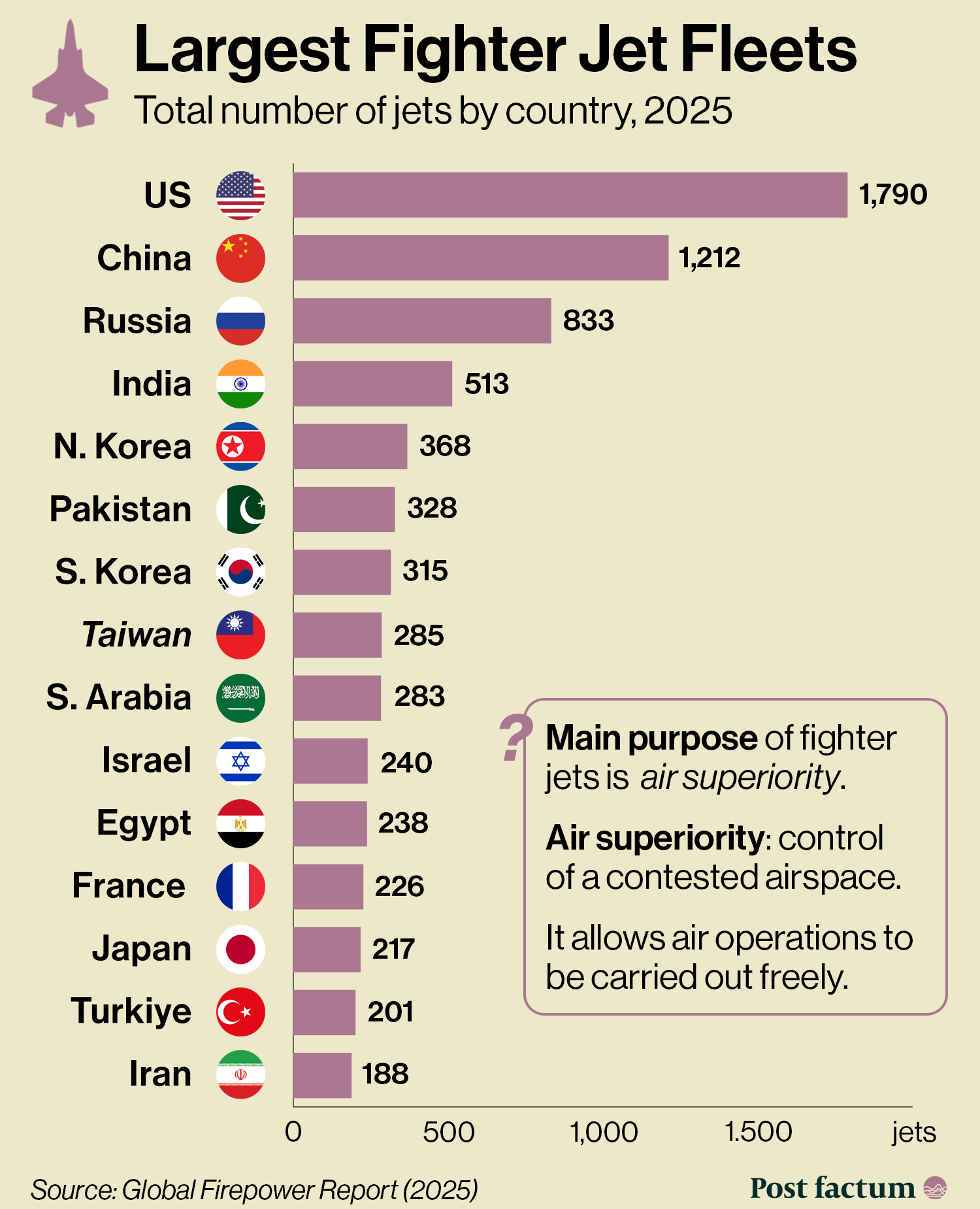
The main purpose of fighter jets is to achieve air superiority: control over the airspace.
Air superiority allows a military to (1) avoid enemy airstrikes, and (2) conduct their own air operations safely.
Advanced fighter jets can strike targets from outside visual range, undetected.
A strong air force and access to more advanced jets matter during a conflict, but also help to prevent one.
Geopolitics: countries can influencing regional and global power balance, and use this as diplomatic leverage (more below).
Fighter jets, as well as drones and missiles, constantly compete with air defence and detection systems.
The US has the largest and most advanced air force today.
An aircraft carrier fleet allows the US to use its planes around the planet.
Some US aircraft have the ability to refuel mid-air, making their range potentially limitless.
China is catching up in both the size and the quality of its fighter jet fleet.
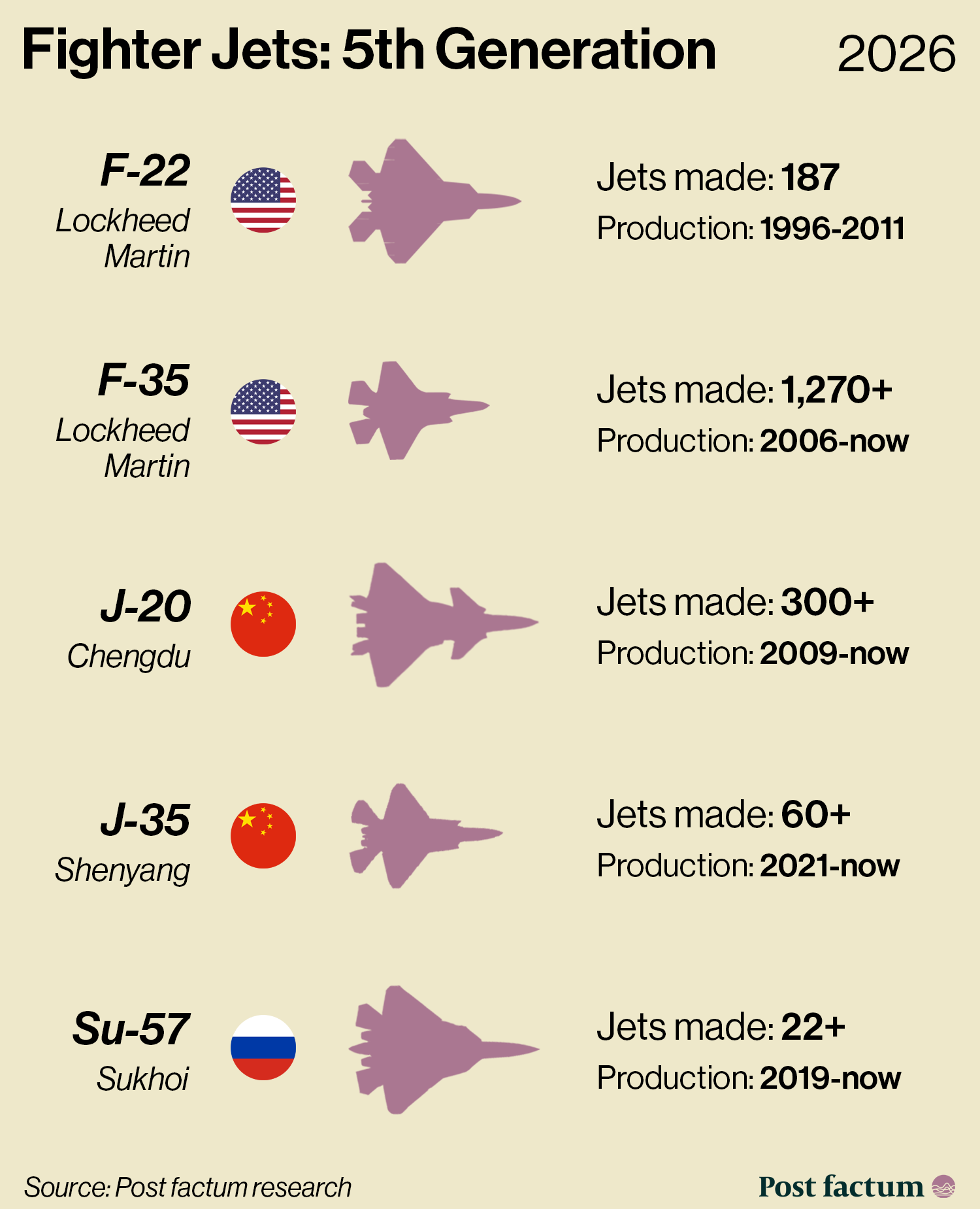
There are currently five 5th generation fighter jets in active service:
F-22 (United States): strongest US air superiority jet, never exported. Production ended in 2011.
F-35 (United States): multirole, exported to US allies globally. The most produced fighter jet.
J-20 (China): in use since 2017, not exported.
J-35 (China): in use since 2025, offered for export, comparable and competing with F-35.
Su-57 (Russia): produced since 2019 at a slow rate, does not have advanced stealth.
Older models of fighter jets can potentially be upgraded.
The F-16 has standard modifications that give it capabilities similar to an F-35, with the exception of its stealth.
Stealth
Key: Radar Cross Section (RCS) is a measure of how much “echo” a jet reflects, indicating how detectable it is.
The F-22 has the lowest RCS at 0.0001 sq m (the size of a bee).
The F-35 is the next stealthiest fighter jet at 0.005 sq m.
The information about Chinese jets is less clear but it is estimated that:
The J-20 has an RCS of 0.025-0.05 sq m, and the J-35’s RCS is around 0.01 sq m.
The Su-57 has an RCS of 0.1 to 1 sq m which suggests it does not have advanced stealth.
Speed
Key: supercruise is the ability of a jet to fly faster than the speed of sound (supersonic) but for a long period of time and without the use of afterburners.
Afterburners inject extra fuel into the jet engine for a short-term boost.
Supercruise is the ability to keep stable supersonic speed (around 1.5 Mach and more).
Most supersonic aircraft can’t supercruise.
The F-22 has the ability to supercruise at up to 1.8 Mach.
The J-20 added the ability to supercruise at 1.8 Mach with its latest WS-15 engine, mass-produced since 2024.
The Su-57 reportedly has the ability to supercruise at around 1.3 Mach.
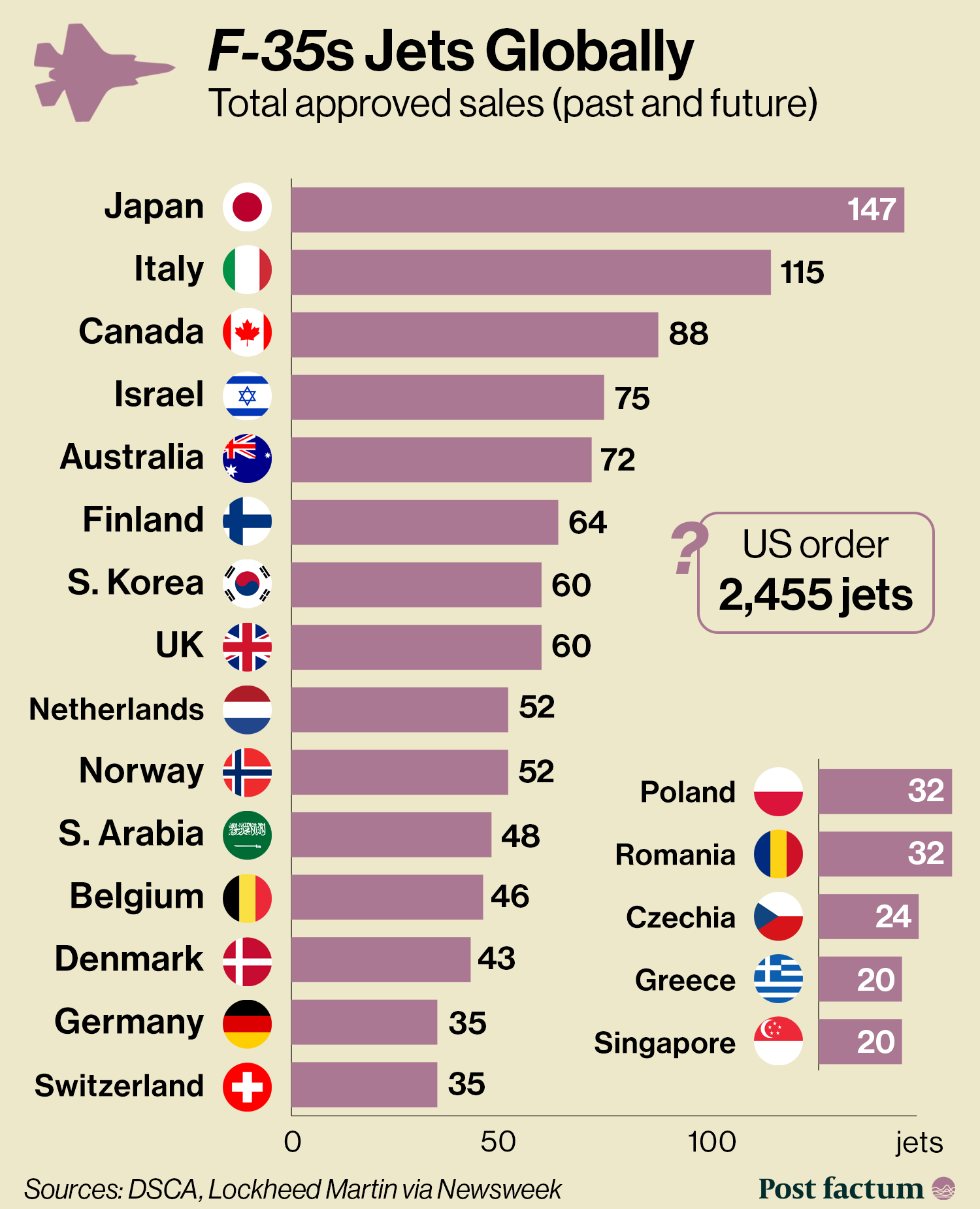
The F-35 is a multirole fighter.
It is less stealthy and quick than the F-22 but has better ground attack capabilities and digital systems.
The F-35 is designed to meet most US needs for fighter jets.
It has a regular model (A), short and vertical take-off version (B), and a model for aircraft carriers (C).
The F-35 was developed in cooperation with some US allies globally and designed as an export model.
Selling the F-35s allows the US to decide which countries get to have a stronger fighter jet, without sharing the F-22 technology.
Israel has been the only country in the Middle East to use F-35 jets.
It uses a unique modification: the F-35I “Adir”, and collaborates on F-35 production.
In 2025, Saudi Arabia agreed a future sale of F-35s.
The model sold would not be as advanced as the Israeli model, as per US law on Israel's "qualitative edge".
Japan and South Korea ordered over 200 F-35 jets, being key US allies in the region.
Taiwan did not receive F-35 jets as the US decided against provoking China with this move.
Instead, the US modernised 144 of Taiwan’s existing F-16 fighters to the latest modification (F-16 Block 70), giving them many 5th gen capabilities.
In 2019, The US removed Turkiye from the F-35 program, despite it being a producing partner:
This was after Turkiye bought S-400 air defence systems from Russia. Turkiye is negotiating a return to the program, and did not start actively using the S-400s.
In 2021, Turkiye requested to purchase 40 F-16s of the Block 70 modification.
In 2024, the US granted this request in return for Turkiye approving Sweden’s entry into NATO, which it previously blocked as one of the members.
China’s J-35 jets are comparable to the F-35 and are offered for export.
Pakistan is the first reported buyer, with growing demand after Chinese jets and missiles were successfully used by Pakistan against India.
6th Generation
The 6th generation of fighters is expected to enter service in the 2030s.
Some major capabilities that are expected:
AI-enabled collaboration between jets
Option for full remote control
Integration with smaller drones (wingmen)
Improved long-range missiles
In 2024, the US paused its 6th gen fighter program to reassess its effectiveness.
In 2025, the program was restarted, and the contract for the new F-47 jet was awarded to Boeing.
It is expected to have a test flight in 2028.
The US also launched a drone wingman program: creating pilotless fighter jets (about a third of the full size) to complement piloted aircraft.
The first prototypes of US drone wingmen flew in 2025.
The US also has a separate 6th generation program for a Navy fighter jet, at an earlier stage of development.
China has two 6th generation fighter programs, led by Chengdu and Shenyang.
J-50 is an air superiority fighter jet, while J-36 is a larger three-engine tailless jet, potentially focused on stealth and ground strikes.
Both prototypes had first flights in late 2024.
China displayed prototypes of drone wingmen in 2025, but they did not test fly publicly.
Europe has 2 collaborative programs, which were both expected to test a flying prototype by 2027.
UK, Japan and Italy collaborate on the GCAP project.
Belgium, France, Germany and Spain are working under the FCAS program. It was left by Sweden but Saudi Arabia is considering joining.
Both programs have made some advances but face delays, uncertainty and internal tensions, including between Airbus and Dassault.
European states may eventually shift to importing the US-designed 6th generation fighter or relying increasingly on upgraded F-35 jets.
Russia, India, South Korea and some other countries have active or announced 6th generation fighter jet programs but none are expected to be available before 2040.
Author Anton Kutuzov
Join Post factum Pro to access the comments section