
Protectionism, Explained
Free Trade vs Tariffs, and more
January 11, 2026
Protectionism is the government policy of restricting international trade.
It uses tariffs and other tools to create barriers for foreign companies to compete with local producers.
Free trade policies, in contrast, promote equal access to all markets for all producers.
Why do countries choose free trade?
Specialisation: countries can focus on industries they are best at, boosting growth.
Efficiency: international competition pushes firms to innovate and improve.
Consumer choice: a greater variety of international products reaches local markets.
Lower prices: absence of tariffs and increased competition decrease prices.
Diplomacy: trade could improve relationships with other countries or avoid conflicts.
Why do countries choose protectionism?
Support local industry: strengthen domestic producers in competition with imported goods.
Job security: to protect employment in industries that might lose out to imports.
Strategic control: to support sectors important for national security.
Development: to give new industries time to grow before facing global competition.
Counter-measures: to stop unfair practices by foreign companies, or to retaliate against protectionist policies of other countries.
In 2025, President Trump announced the largest tariff increase in modern US history, affecting global trade and financial markets.
We analysed its mid-term effects in the latest report on Post factum Pro, where we revisit the most impactful events of recent months.
The World Trade Organization (WTO) is the body overseeing trade, setting rules, promoting open markets, and helping countries resolve disputes.
In 2001, the WTO launched the Doha Round to continue reducing trade barriers in the 21st century.
Negotiations later stalled because of:
Agricultural protectionism: richer nations like the US and the EU resisted cutting subsidies that protect local farmers.
Large and fast-growing economies: some nations opposed terms favouring countries like Brazil, China or India.
Political challenges: lack of motivation to achieve consensus among 150+ members.
The paused negotiations motivated countries to protect their own interests with a mix of free trade and protectionist measures.
Free trade continues within regional agreements or two-country (bilateral) deals.
The European single market is an example of a free trade area, with more around the globe.
With such Free Trade Agreements (FTAs), tariffs are mostly removed, and non-tariff barriers like product licensing are reduced.
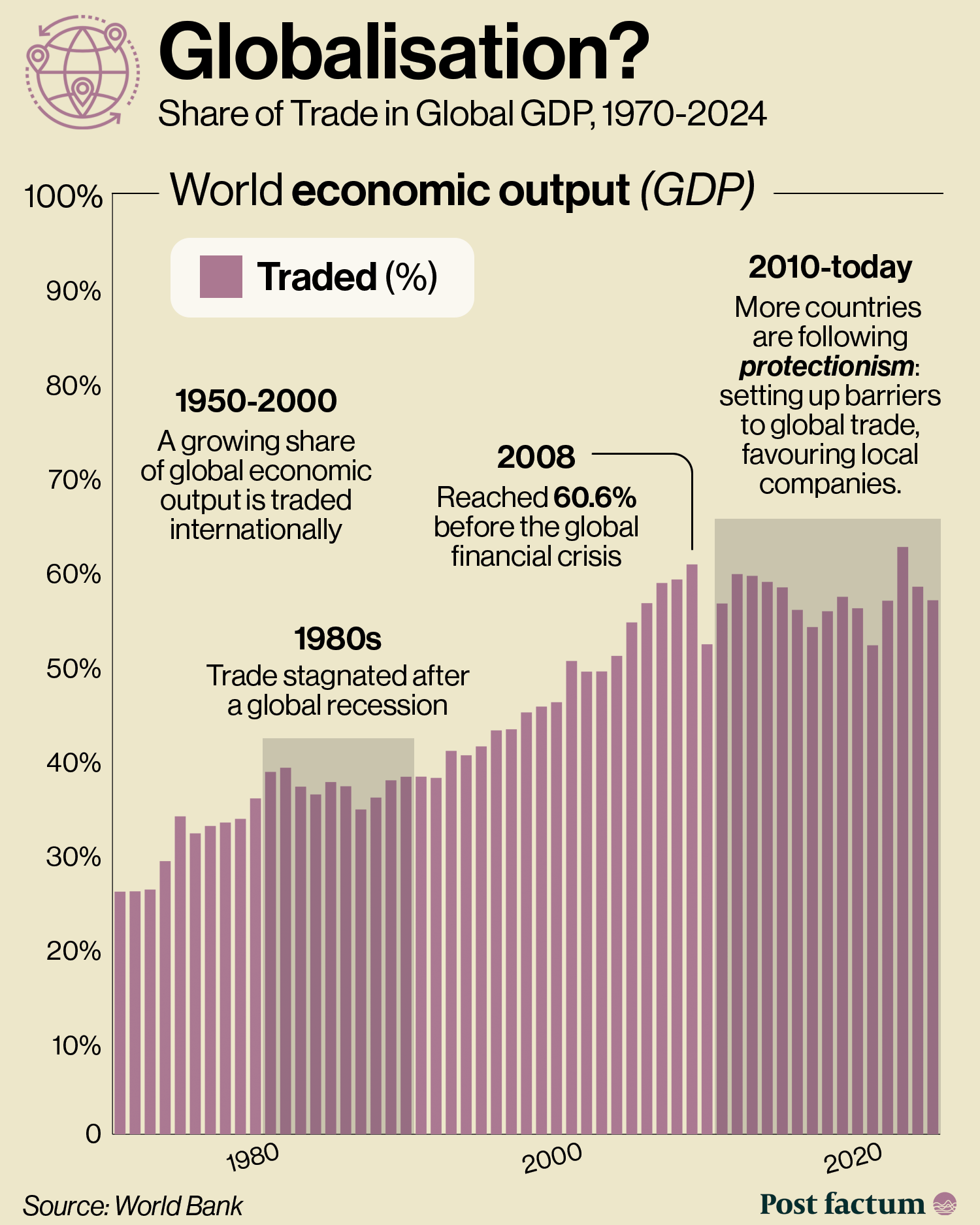
However, free trade as a share of the world’s economic output has stagnated since the global financial crisis of 2008.
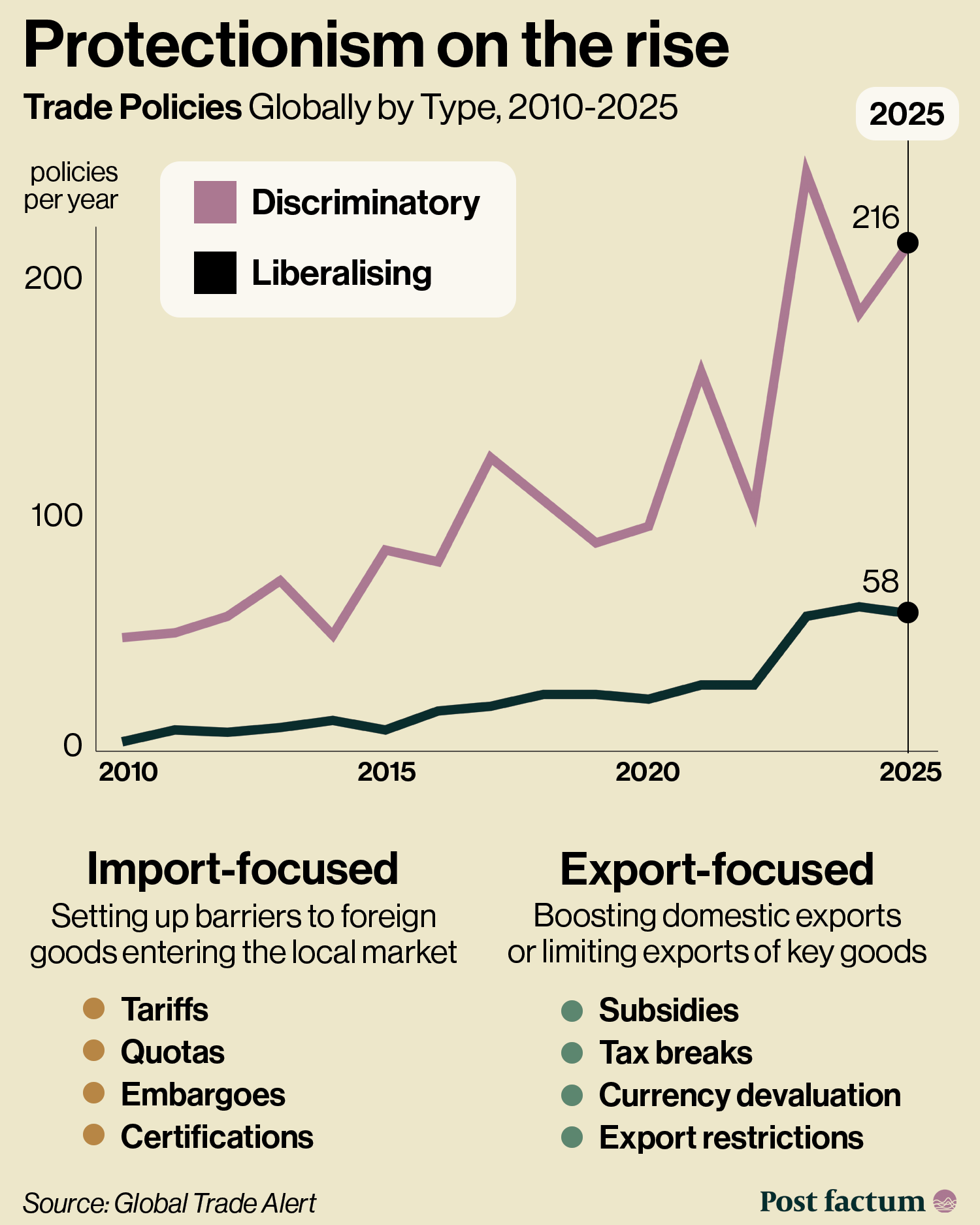
Protectionist measures have been increasingly popular with policymakers since 2010.
Discriminatory trade policies (those changing terms for specific countries) appeared 3 times more often than liberalising ones in the 2020s.
A tariff is a tax on imports from another country.
Historically, it has been the main tool to protect local industries from foreign competition.
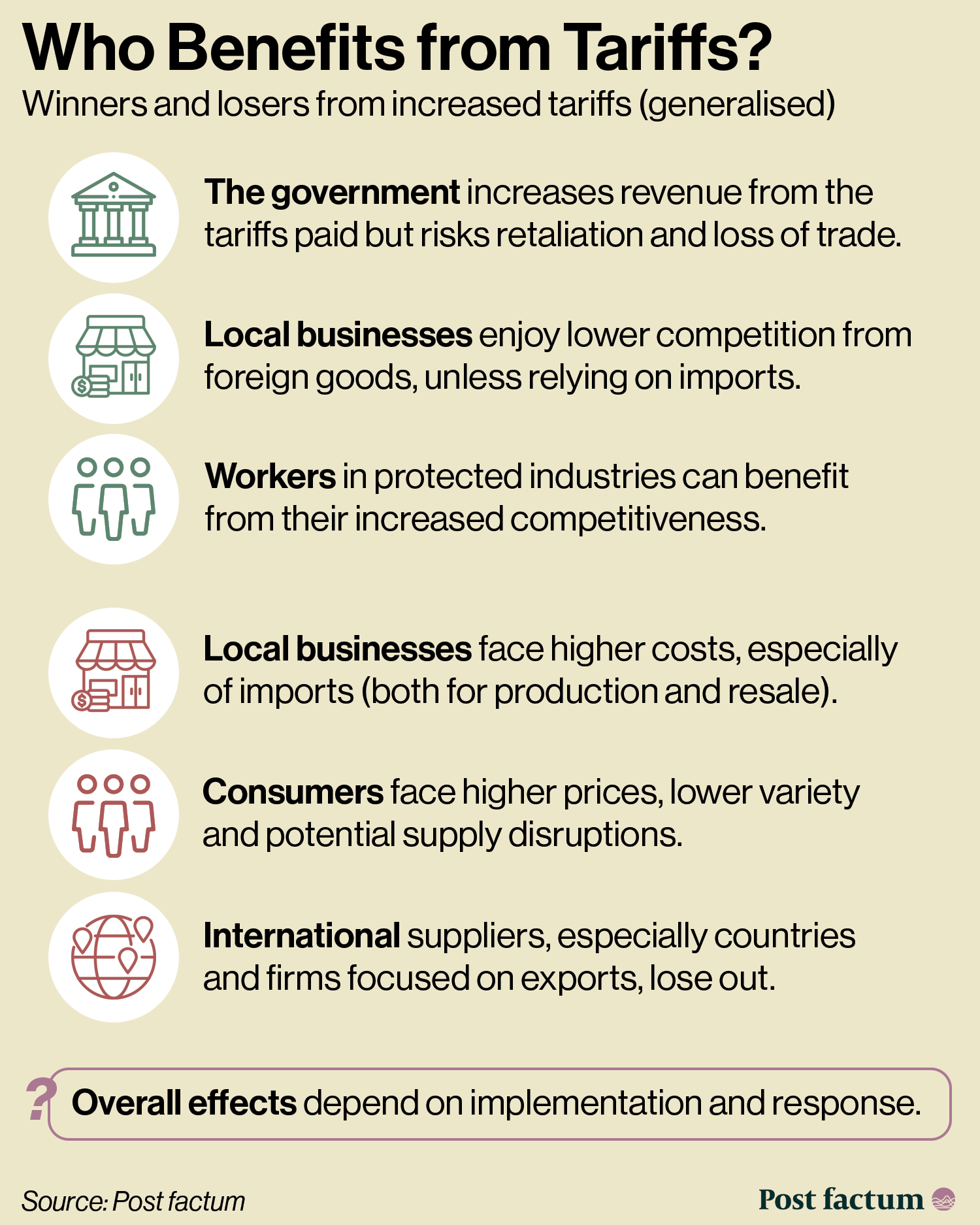
Tariffs normally raise government revenue in the short-term, but the effect fades if overall imports decrease in response to the tariffs.
In 2018, Trump added 25% tariffs on EU steel and 10% on aluminum, to protect national industries and reduce the trade deficit.
The EU responded with tariffs on US motorcycles, jeans, bourbon and steel products.
Both got WTO approval to set extra tariffs to counteract US subsidies to Boeing and European subsidies to Airbus aircraft makers.
In 2020, China set an 80.5% tariff on Australian barley, citing price dumping and unfair subsidies.
This came after some Australian officials called for an investigation into the origin of the COVID‑19 pandemic, and the handling of the outbreak by China.
The tariff was lifted in 2023.
In Africa, the Alliance of Sahel States put a symbolic 0.5% tariff on all imports from ECOWAS states in 2025, having left the bloc in prior years.
This tariff raises some revenue while technically breaking ECOWAS free trade rules.
Non-tariff measures
WTO limits the use of tariffs, so many countries use other barriers to trade, such as quotas or product certifications.
Quotas set a limit on how much of a product can be imported.
The EU uses quotas on some farm goods, including limits applied to Argentina, Brazil and Ukraine.
An import ban (embargo) is a complete prohibition of imports from somewhere.
Russia banned some food imports from Australia, the EU and the US after the 2014 sanctions.
Governments can require foreign products to get licenses certifications, or meet technical standards which complicate importing.
India introduced the Bureau of Indian Standardswhich issues regulations on testing, packaging and other.
Countries can use export restrictions to control international sales of strategic goods.
The US has imposed licensing and export bans on semiconductors since 2019, especially targeting China.
Countries can subsidise their own exporters through grants or tax breaks, making local products cheaper abroad.
China subsidised the exports of solar panels, electric vehicles and other goods globally.
Digital data protectionism: in recent years, countries used more measures to limit cross‑border data flows or regulate how foreign tech firms handle data.
In the EU, regulations promote individual rights to personal data, and market competition in tech.
China requires companies to store sensitive data locally, as do some other states.
Author Ostap Salovskyi
Editor Anton Kutuzov
Thank you for reading!
This week on
Effects, Current Status and more
Join Post factum Pro to access the comments section