
US Push for Greenland, revisited
Geopolitics of the Arctic, and the Largest Island
Published: March 19, 2026
Greenland is a self-governing territory of Denmark and the world's largest island, with about 57,000 people.
Its central location in the Arctic gives Greenland military and trade importance. The island is also rich in some natural resources.
In late 2024, Trump re-started his push to take control of Greenland, calling it a national security priority.
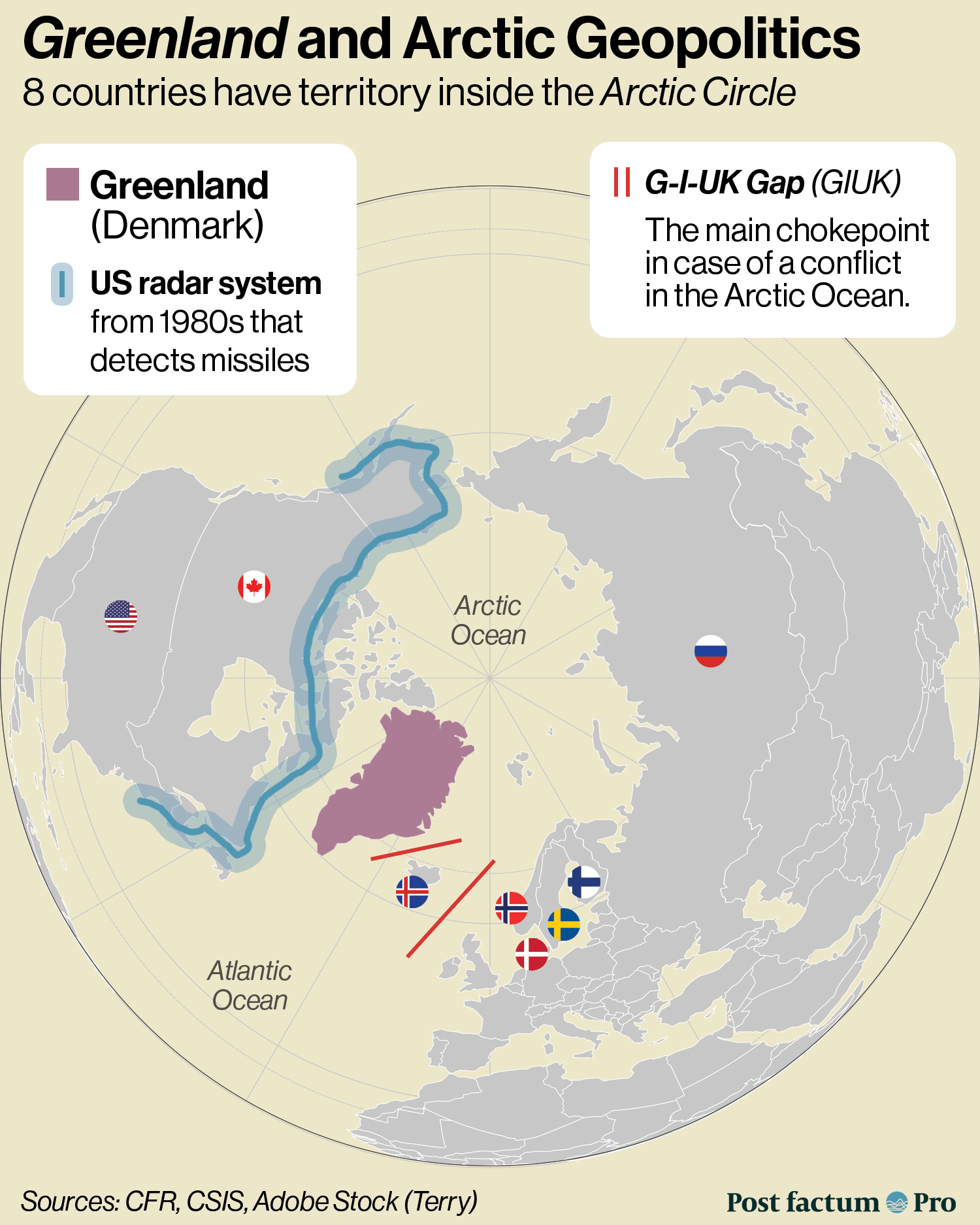
Arctic defence
The US has had a military base in Greenland since 1951 under a NATO agreement with Denmark.
The base is the northernmost US military site in the world and hosts early-warning radar that tracks missiles and communicates with satellites.
It is part of a North American radar network designed to detect missiles crossing the Arctic.
Denmark has historically allowed the US presence because it does not have the ability to defend Greenland on its own.
However, in 2025 Denmark announced a $6.5 billion Arctic defence package, including new ships, patrol aircraft, radar and drones.
Russia controls over 50% of the Arctic coastline and has re-opened 14 airfields in the region since 2014.
China calls itself a "near-Arctic state" and has sent icebreaker and research ships into Arctic waters, mostly near Alaska and Russia's northern coast.
Canada and the US detected 95 Russian and Chinese air incursions into their airspace: 91 over Alaska, 4 near Canada and 0 near Greenland.
Arctic trade
Melting sea ice is opening new shipping routes through the Arctic.
The number of ships in the Arctic grew by 37% between 2013 and 2023.
The 2 main Arctic routes run along Russia's northern coast and through the Canadian Arctic.
Russia's route: about 38 million tonnes of cargo in 2024, or 0.3% of global maritime trade.
Canada's route: only 13 ships completed the full passage in 2025, mostly cruise and cargo ships.
As ice continues to melt, a new shipping route directly through the Arctic is expected to open, linking Asia and Europe by sea through the north.
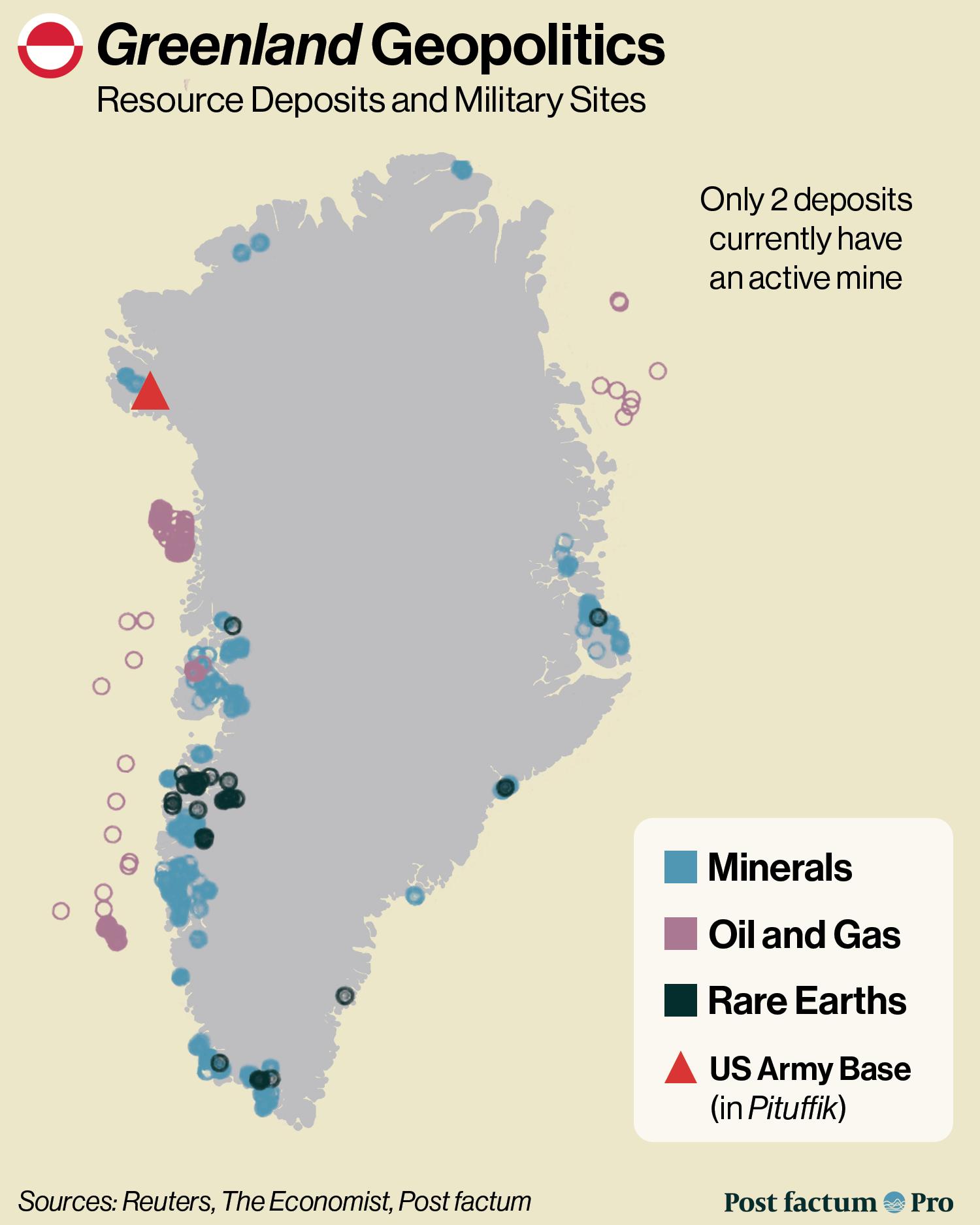
Arctic resources
Greenland has deposits of most critical minerals, including rare earths, graphite, copper, nickel, zinc, uranium, gold and diamonds.
However, about 80% of Greenland is covered by ice, making mining costly and difficult.
No towns on the island are connected by road, also limiting mining potential.
Oil and gas extraction has been banned in Greenland for environmental reasons since 2021, and mining projects have faced delays due to regulations and local opposition.
Greenland currently has 2 working mines: a gold mine reopened in 2024 and a mine producing material for fibreglass and paint.
Running a mine in the Arctic costs 2 to 3 times more than in regular climate.
The US push for Greenland
Trump first expressed interest in buying Greenland in 2019, during his first term in office.
The Danish Prime Minister called the idea "absurd", and Trump cancelled a planned visit to Denmark.
In December 2024, Trump renewed his push. He then threatened tariffs on Denmark and initially refused to rule out military action.
In January 2026, Trump and the NATO chief announced a "framework" to update the 1951 US-Denmark defence agreement, including broader US military access to Greenland.
Denmark and Greenland said nothing had been signed, and both rejected any change in the island's status.
European allies supported Denmark, warning that a forced takeover would set a dangerous example for territorial claims against smaller nations, such as Russian annexation of Crimea or China’s potential seizure of Taiwan.
In a January 2025 poll (latest data), 85% of Greenlanders did not want the island to become part of the US, while 6% supported it and 9% were undecided.
Greenland's Path to Independence
Greenland was a Danish colony until 1953, gained its own parliament in 1979, and received broader self-governing powers in 2009.
Since 2009, Greenland has the legal right to declare independence through a referendum approved by the Danish parliament.
56% of Greenlanders said they would vote for independence, but 45% said they would not support it if it lowered their standard of living.
Almost 90% of Greenlanders are ethnic Inuit people, historically oppressed by Danish colonists.
In March 2025, the centre-right opposition won Greenland's election with about 30% of the vote, running on a platform of gradual independence and economic development.
However, Greenland's economy depends on annual Danish subsidies of about $610 million to cover half the public budget.
Denmark also pays for Greenland's police, justice system and defence, bringing total annual spending to about $1 billion.
Fishing accounts for over 90% of Greenland’s exports.
In March 2026, Greenland's governing coalition lost a partner party, weakening the united front against the US push.
Denmark is holding a general election on 24 March 2026, with the Prime Minister seeking a 3rd term after her response to the Greenland dispute raised her ratings.
In the US, a framework called COFA is discussed: it is currently used with 3 Pacific Island nations, granting US exclusive military access in exchange for protection, without losing independence.
Update (06.09.2026):
In January 2026, Trump dropped his tariff threats and announced a "framework" for a deal on Greenland, covering US military access, missile defence and minerals.
The US, Denmark and Greenland set up a working group to negotiate an updated version of the 1951 defence agreement, aiming for a deal before the end of 2026; no agreement has been signed as of September 2026.
In Denmark's March 2026 election, the ruling Social Democrats had their worst result since 1903, but the Prime Minister formed a new coalition and kept her post.
Trump repeated his claim to Greenland at the NATO summit in July 2026; Denmark's intelligence service now lists the US among threats to Danish security.
Thank you for reading!
Leave a comment below: