
India-Pakistan 2025 Clash, revisited
Shifted Power Balance in Asia
May 14, 2026
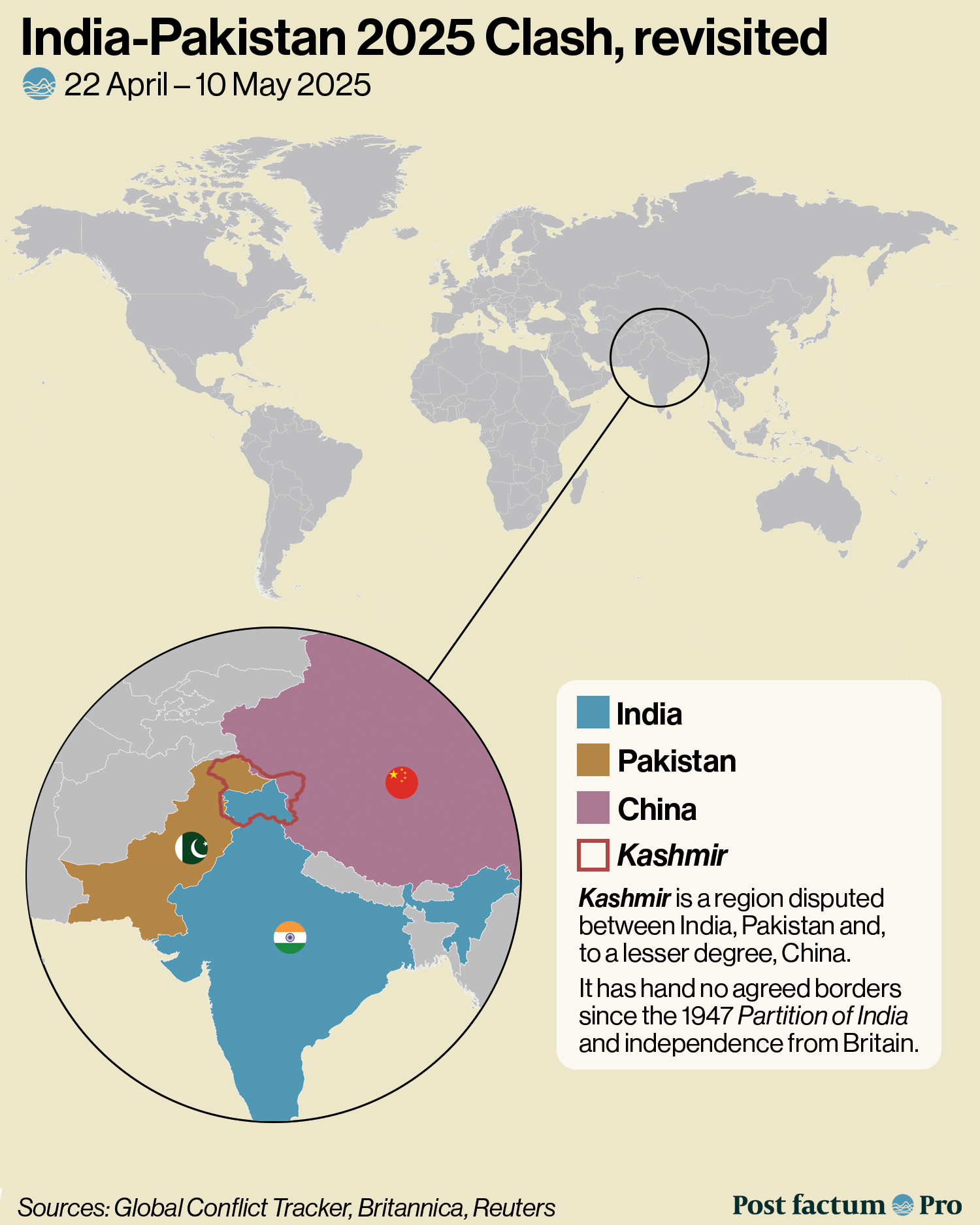
In May 2025, India and Pakistan fought a 4-day war following a terrorist attack in Indian-administered Kashmir.
The clash showed the effectiveness of Chinese-supplied weapons in modern air combat, leading India to rethink its air force modernisation.
The terrorist attack
On 22 April 2025, 3 terrorists attacked tourists in Indian-administered Kashmir, killing 26 people.
The victims included 24 Hindu tourists, 1 Christian tourist and 1 local Muslim.
A Pakistan-based militant group claimed responsibility, then took this back 3 days later, claiming a cyberattack on its accounts.
The militants opposed non-local settlement in Kashmir, a tension that grew after India removed the region's special autonomy in 2019.
Before the strikes, India had also suspended a long-running water-sharing treaty with Pakistan.
On 7 May 2025, India launched missile and air strikes on Pakistan and Pakistan-administered Kashmir, starting the 4-day conflict.
The fighting involved missile strikes, drones, air strikes and artillery shelling, with civilian casualties reported on both sides.
A ceasefire was announced on 10 May after a call between Indian and Pakistani defence officials. Both sides claimed victory.
Shortly after, President Trump claimed responsibility for helping to settle the conflict.
India actively rejected this, claiming no real US involvement.
Diplomatically, India avoids situations where Pakistan and India are seen as equals, and frames any clashes as local crises.
Military lessons
The clash revealed the strength of Pakistan's Chinese-supplied air combat system.
Pakistan shot down 1-6 Indian fighter jets, including 1 Rafale, India’s flagship 4.5-generation jet.
Long-range Chinese missile: the PL-15E air-to-air missile hit Indian jets from around 200 km, beyond what India had planned for.
Networked combat: Pakistan combined Chinese fighters, long-range missiles and radar into a single system.
Squadron gap: India's air force fielded around 29 fighter squadrons against an authorised 42 by late 2025.
Pakistan also reported shooting down Israeli-made suicide drones used by India.
India's tactical error on day 1 was hitting militant infrastructure first instead of Pakistan's air defences.
After adjusting tactics, India hit Pakistani military airfields without more aircraft losses in the later days of the war.
India also intercepted a Pakistani Fatah-II missile near an air base.
In late 2025, UN Special Rapporteurs concluded India's strikes lacked a lawful self-defence basis under international law.
Pakistan's Chinese arms
In January 2026, China's defence industry regulator confirmed the J-10 recorded combat results in 2025.
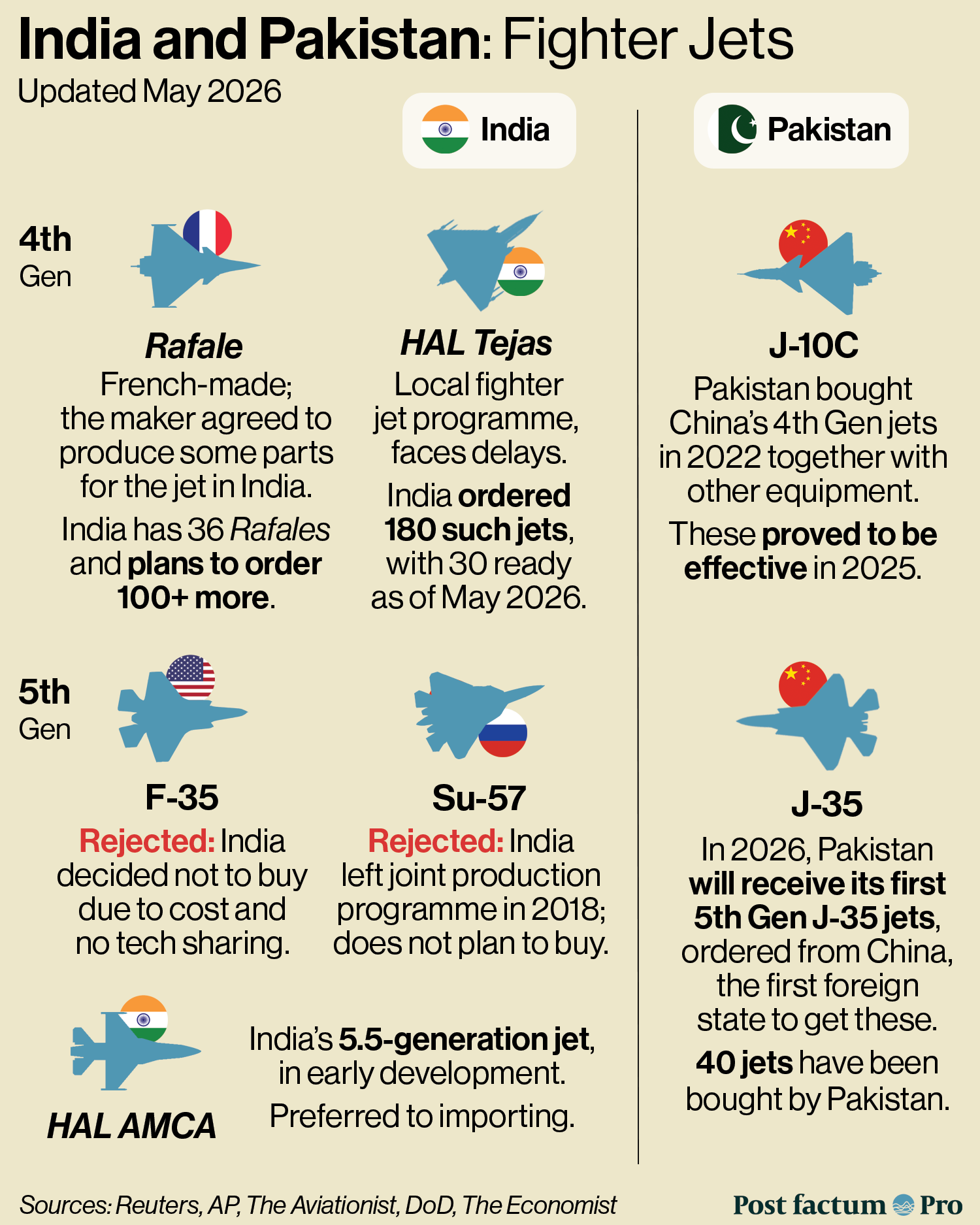
Pakistan signed a deal for 40 Chinese J-35 stealth fighters, becoming the first foreign operator of a 5th-generation Chinese jet.
Pakistan also plans to buy China's HQ-19 air defence system, announced in June 2025.
In September 2025, Pakistan and Saudi Arabia signed a mutual defence pact, treating aggression against one as aggression against both.
India's fighter strategy
India's air force operates 29 fighter jet teams (squadrons), below its target of 42.
The retirement of the fleet of 40-year-old MiG-21s in 2025 brought India closer to Pakistan's squadron count and far below China's larger air force.
India's new plan has 3 steps:
Rafales now: India signed for 26 naval Rafale jets in April 2025, and gave preliminary approval in February 2026 for 114 more Rafales for the air force.
Tejas Mk1/2 locally: in 2025, India ordered 97 more Indian-made jets worth roughly $7 billion, bringing the total planned to 180 aircraft. The programme faces delays.
AMCA stealth jet: India approved its 5th-generation local fighter jet programme, with 5 prototypes planned, and bidding now open to domestic firms.
India declined Trump's F-35 offer, citing its self-reliance policy and the issue of restricted source-code access.
India had also co-developed the Russian Su-57 fighter before leaving the programme over quality concerns in 2018.
India decided to pursue a local 5.5-generation fighter jet programme that would allow for independent serial production, even if it takes a long time.
Some reports suggest India is considering taking part in one of the European 6th-generation fighter jet programmes.
The Tejas programme faces delays due to slow engine supplies, with first deliveries planned for 2027-28.
The 2025 clash shifted India's fighter debate from individual jets and weapons to networked air-combat systems.
Author Anton Kutuzov
Thank you for reading!