
Georgian Protests, explained
Russian Influence vs European Integration
Published: January 23, 2026
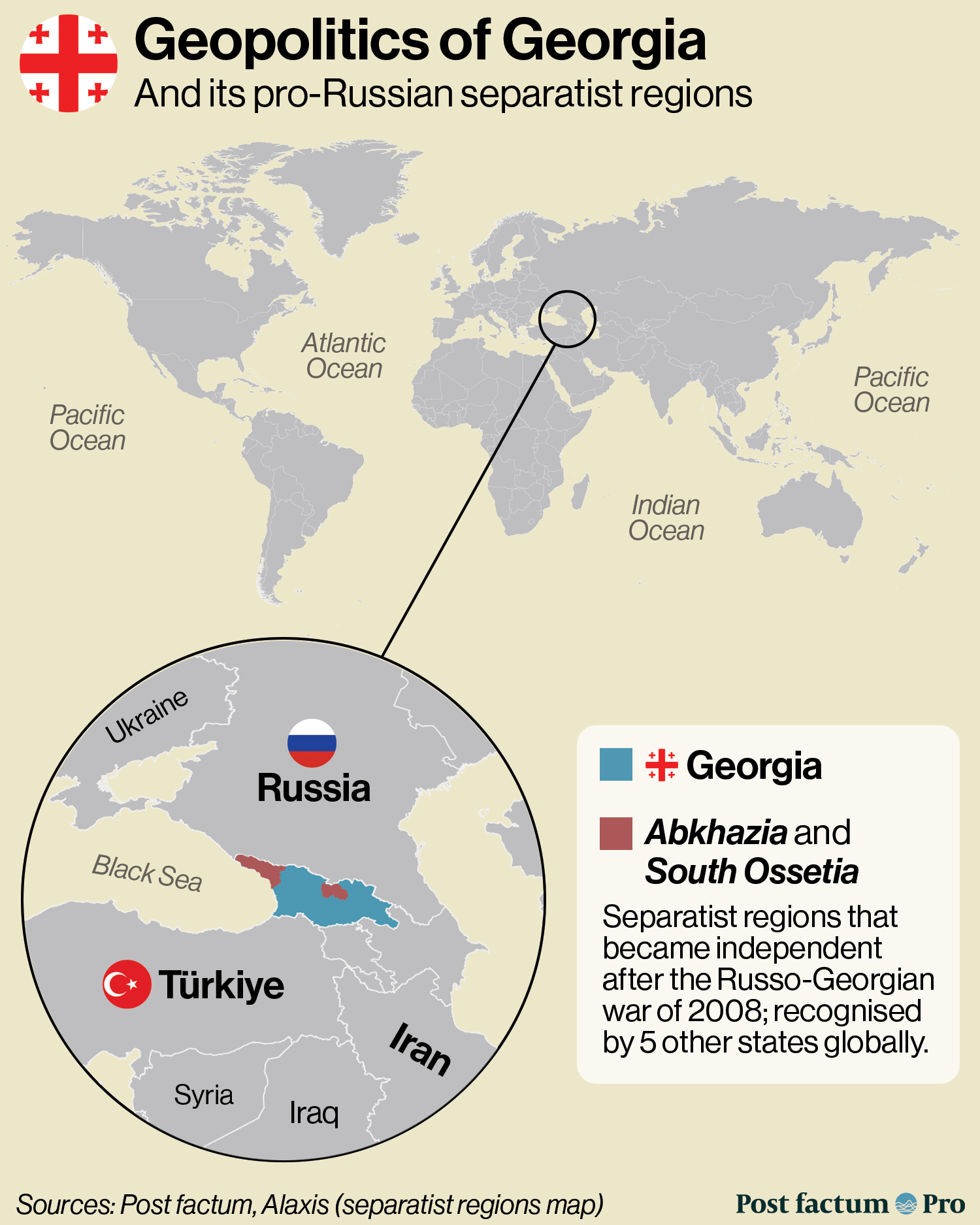
Georgia was part of the Soviet Union and shares over 900 km of border with Russia.
In 2003, a non-violent revolution in Georgia brought a pro-Western government to power.
Joining the European Union and NATO became a priority, while Georgia tried to distance itself from Russian influence.
Russia opposed Georgia’s ambitions of joining NATO.
Russia increased its influence over South Ossetia and Abkhazia, separatist regions of Georgia.
This included giving Russian passports to locals, increasing military presence and economic ties.
In 2007, speaking before Western leaders, Vladimir Putin criticised US global dominance and described NATO’s expansion as a threat to Russia.
In 2008, at a NATO Summit, Ukraine and Georgia were both promised a membership in the alliance.
However, they did not get a “membership action plan” that would have given a clear path to joining.
Reasons included:
Ties with Russia: some NATO members depended on Russian energy sources and/or wanted to avoid confrontation.
Governance: corruption and weak democratic institutions remained an issue both in Georgia and Ukraine.
Separatist regions: NATO is cautious about admitting members with territorial disputes, as it is unclear if such a country is currently at war.
In August 2008, Russia invaded Georgia.
At first, Russian-backed separatists in South Ossetia opened artillery fire on Georgian positions.
Georgia sent its army into South Ossetia.
Russia accused Georgia of genocide and attacked the country by land, air and sea.
The war lasted 6 days and resulted in the death of over 850 people.
Over 190,000 Georgians were forced out of the separatist regions.
Around 16,000 Georgian soldiers were deployed, compared to over 70,000 Russian troops.
After the war, Russia recognised South Ossetia and Abkhazia as independent states.
They are recognised by 4 other countries: Nauru, Nicaragua, Syria and Venezuela.
Georgia lost control over 20% of its territory, which it considers occupied by Russia.
Russia has a military presence in both regions.
Georgia cut diplomatic ties with Russia.
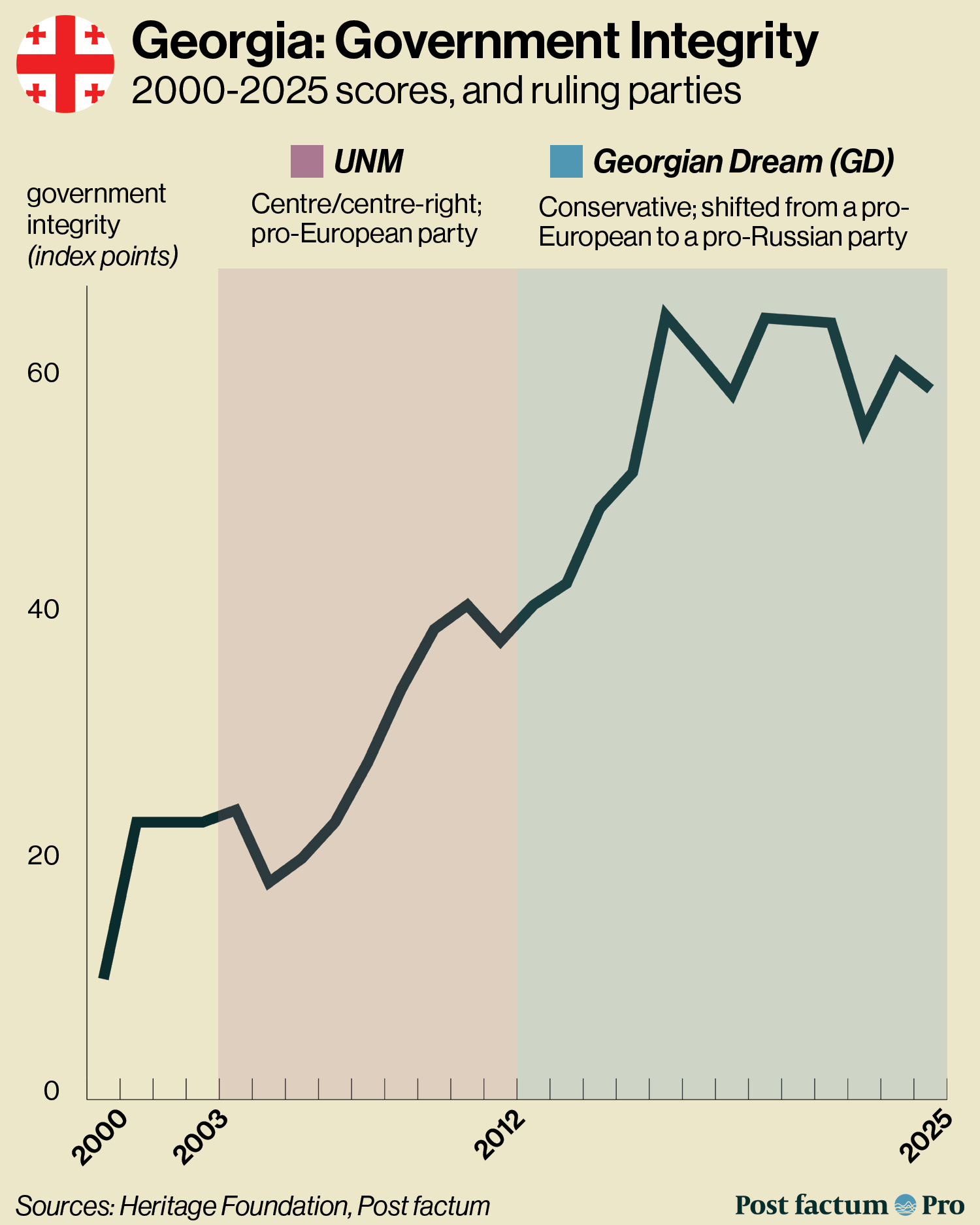
Georgian Dream (GD) is the current ruling party of Georgia.
When GD entered office in 2012, it aimed to both strengthen ties with the EU and restore relations with Russia.
GD reopened a channel for diplomatic communication between the two states. However, there are still no formal relations.
A 2012 poll showed that over 80% of Georgians were in favour of further dialogue with Russia.
Under GD, Georgia increased its trade with Russia.
In 2013, Russia lifted its ban on Georgian agricultural and wine exports, imposed in 2006 during a period of tensions.
Bilateral trade increased from $0.5 billion in 2012 to $1.6 billion in 2021.
At the same time, GD also deepened relations with the EU.
In 2023, Georgia was granted EU candidate status.
Trade with the EU grew from $2.9 billion in 2013 to $5.4 billion in 2024.
Shift towards Russia
From 2022, Georgia’s foreign policy was affected by:
Security environment: Russia’s invasion of Ukraine increased fears of a new invasion.
EU conditions: the EU demanded democratic reforms to continue the process of joining the bloc.
GD sees EU demands as political interference.
GD says that closer alignment with the West risked dragging Georgia into a war with Russia.
Georgia has no international security guarantees and deals with the risk of a conflict with Russia.
Russian armed forces have around 1.3 million personnel, compared to around 55,000 soldiers in the Georgian military.
69% of Georgians consider Russia the main security threat.
Between 2021 and 2024, trade between Georgia and Russia increased by around 55%, reaching $2.5 billion.
In 2024, Georgia imported 25% of its gas from Russia, up from 15% in 2021.
Russia supplies over 40% of Georgia’s oil products.
The GD government refused to join Western sanctions against Russia.
As of 2025, 40,000 companies owned by Russian citizens are registered in Georgia, with 75% registered after 2022.
Revenues from Russian remittances, tourism, and exports account for over 10% of Georgia’s GDP.
Remittance is a payment sent by a migrant back to his or her home country.
Current protests
In late 2024, GD won another term in power, with 54% of the votes.
The outcome was rejected by the opposition.
There is some evidence of fraud, including:
Pressure on public sector workers to support GD
Restrictions on observer access inside polling stations
Irregularities in voter identification procedures
However, GD was likely to form a ruling coalition and remain in power, according to independent polls.
The EU rejected the results of these elections. In response, GD suspended integration talks with the EU until 2028.
Protests have taken place daily for over 400 days and are still ongoing.
Demonstrators ask for new elections, the resumption of EU integration, and the reversal of democratic backsliding.
Over 74% of Georgians are in favour of joining the EU.
At least 6 opposition leaders have been jailed for inciting protests and for supporting international sanctions against Georgian politicians.
Hundreds of protesters reported physical violence and beatings in detention.
A recent investigation found that Georgian police added a banned chemical weapon camite to the water sprayed on protesters in 2024.
GD passed a number of authoritarian laws since 2022, and increasingly since 2024, targeting opposition parties, protesters and “foreign agents”.
Thank you for reading!
Authors Finlay Dunseath, Simone Chiusa
Editor Anton Kutuzov
Leave a comment below: