
Venezuela, 6 Months after Maduro
Oil, Geopolitics and Democracy
23 June 2026
Venezuela's leader Nicolas Maduro and his wife were captured by the US military on 3 January 2026.
Air defences were attacked and disrupted from the air, before an elite special forces unit flew to Maduro's location.
At least 23 Venezuelan soldiers and 2 civilians were killed during the intervention, as well as 32 Cuban soldiers. 7 US troops were injured.
Maduro faces charges for narco-terrorism and drug trafficking. The maximum sentence possible is life imprisonment.
The case progresses with no date for the next trial yet.
Effects of US intervention in Venezuela:
Maduro's replacement: his vice president, Delcy Rodriguez, became acting president, the first woman to hold presidential powers in Venezuela.
Political continuity: about half the cabinet are Maduro-era officials; the government remains loyal to him, and aims to return the ex-president and his wife.
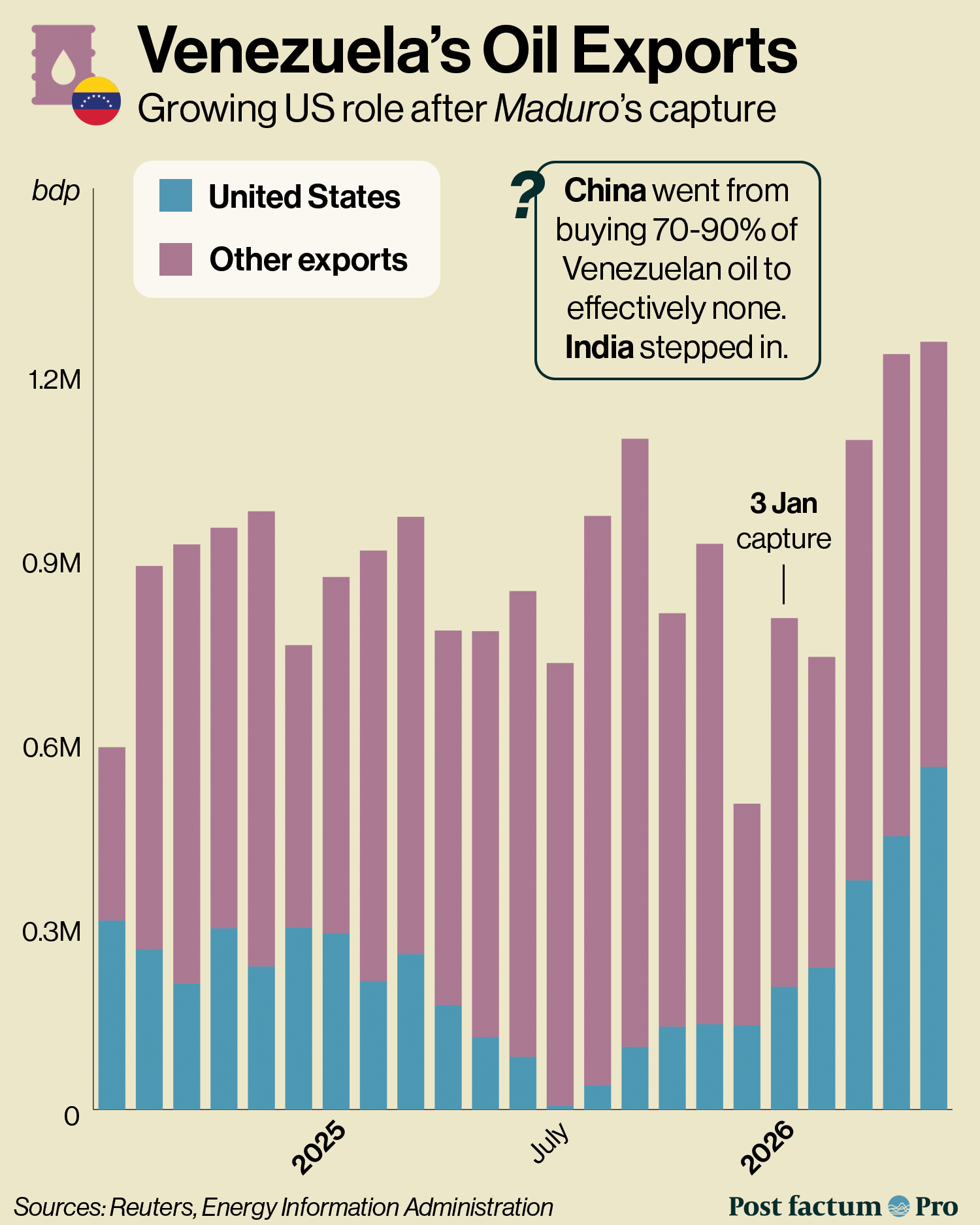
Oil market re-shaped: the US now controls Venezuela’s revenue from oil exports; it eased sanctions and allowed more business with Venezuelan oil companies.
China pushed out: China's share of exports fell from 70-90% towards almost zero by June 2026. India stepped in as a new large buyer.
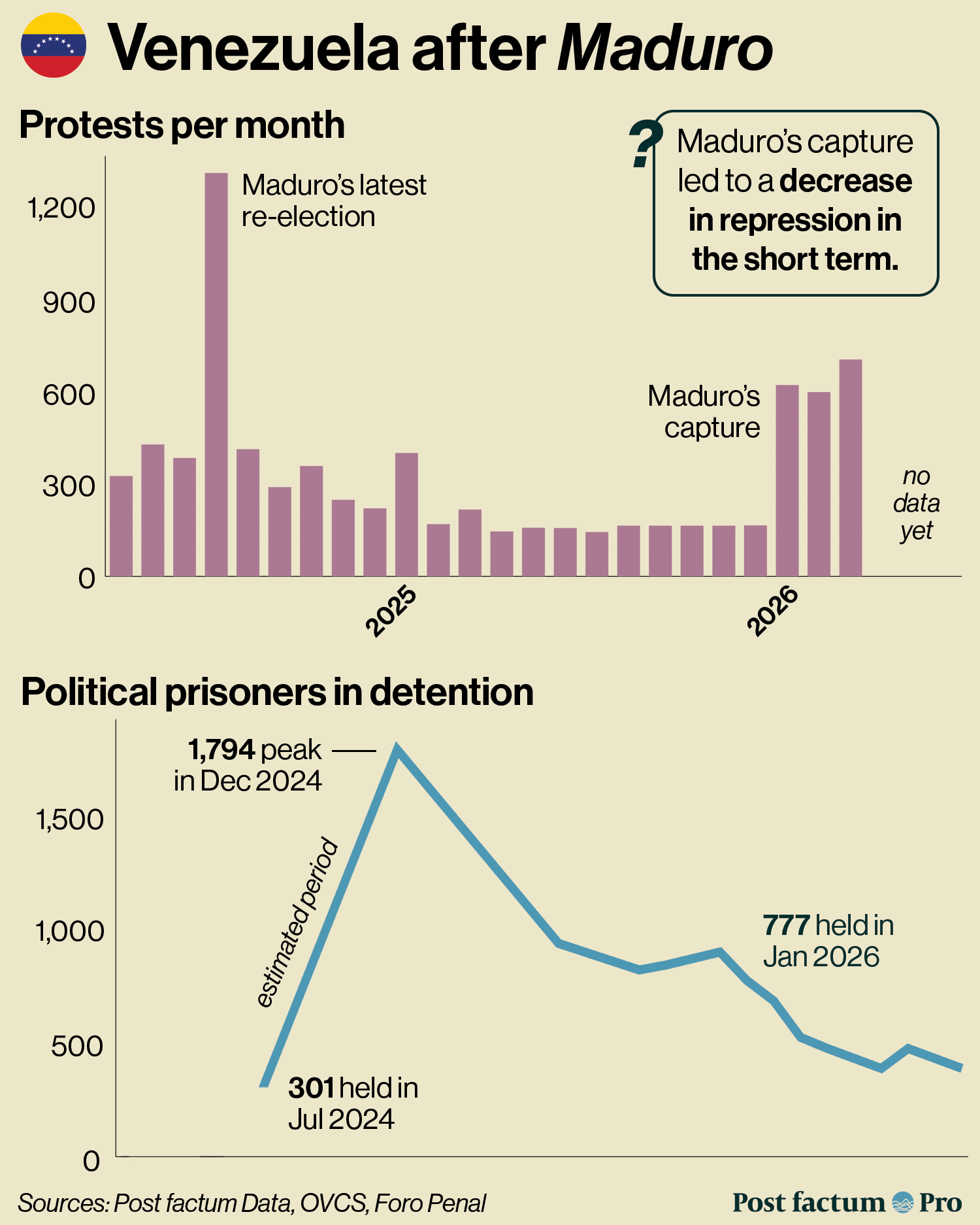
Reasons for hope: some political protests are now tolerated, under US pressure and threat, with potential for presidential elections to be held in the next year.
Oil and economy
Venezuela has been in deep economic crisis for over 10 years, with extreme poverty and high inflation.
The government has been printing more and more money to fund its spending as the once-strong oil industry declined under sanctions and poor management.
Venezuela holds one of the world's largest foreign debts at around 200% of its GDP (over $150 billion).
After the intervention, Venezuela agreed that all revenue from its oil exports would be deposited in the US first and used only with US approval.
So far, sale of around $5 billion worth of oil was planned, and over $500 million was already sent to Venezuela to keep the government operating under US oversight.
However, there is little public information about this arrangement, including how much oil was sold, at what price, how much money was sent to Venezuela and how it was spent.
The US controls who is allowed to buy the oil, with the main buyers now being Indian and US oil refineries.
Oil ‘privatisation’: a new law has allowed companies other than the state-owned oil giant to enter the oil market independently.
Oil exports reached 1.2 million barrels per day (bpd), a 7-year high.
Reaching 3 million barrels per day would need around $183 billion of investment, more than double the Venezuelan GDP.
Politics and democracy
Maduro's deputy re-shuffled the cabinet in March 2026, but most ministers are long-time government insiders.
The new defence minister is a former head of the intelligence service who previously oversaw violent crackdowns on opposition.
No election date has been set as of June 2026.
The opposition estimates that updating the electoral system would take 9-10 months.
This includes updating the list of voters, which excludes about 8 million emigrants who left during the crisis.
A controversial amnesty law passed in February 2026 which allowed some political prisoners to be released; however, it excluded some high-profile cases and anyone who encouraged foreign intervention.
Around 389 political prisoners are still held by Venezuela in June 2026.
Venezuela recorded around 600 protests in both January and February 2026, as the repression of the past year has been eased under US demands.
February youth marches were broadcast on national television for the first time in years.
The opposition leader Maria Corina Machado, who won the Nobel Peace Prize in 2025, plans to return to Venezuela by the end of 2026.
The 2024 election remains disputed, with the opposition's count showing its candidate winning with 67%.
In June 2026 a US strike inside Venezuela killed the leader of Tren de Aragua, a Venezuelan international gang listed by the US as a foreign terrorist group since 2025.
The US frames its intervention as anti-drug action, claiming that Maduro led a cartel that backed the gang, a claim Venezuela denies.
Cuban Crisis 2026
Cuba has been a one-party socialist state since 1961, which has been an ideological enemy of the US through the Cold War and since.
For the last 20-30 years, Venezuela has been the main supplier of oil to Cuba.
From late January 2026 the US blocked oil tankers bound for Cuba, cutting supply.
Cuban food output fell about 60%, and medicines dropped to around 30% of normal supply.
3 Things to Look Out For:
The election: Venezuelans await a date for a potential presidential election. The constitution requires a vote within 30 days of the post becoming vacant, but it was officially ruled that Maduro is only temporarily absent.
Cuba: with oil supply in US hands, Cuba has already implemented some of the most free-market economic reforms since the 1961 revolution. The US issued a criminal accusation against some Cuban officials, including Raul Castro, and may be looking to replace the current president.
Guyana: a Venezuelan neighbour with large under-developed oil reserves has been a potential target for an invasion or annexation by Maduro’s regime.