
US Politics, explained
Congress, Lobby Groups, Filibuster and more
21 June, 2026
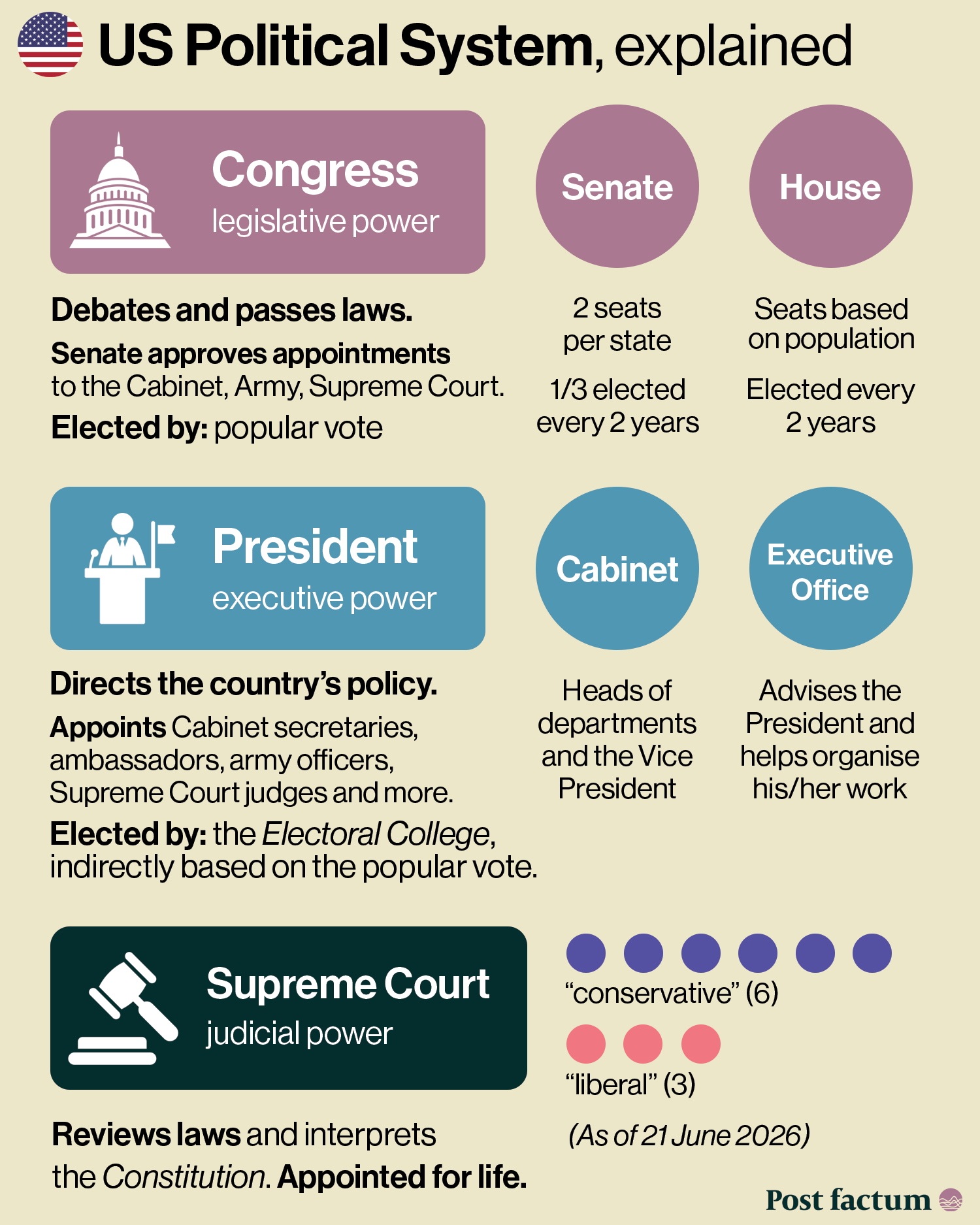
The US Constitution divides power in the country:
Horizontally: making laws (legislative power), applying laws in practice (executive power) and settling disputes (judicial power) are separated.
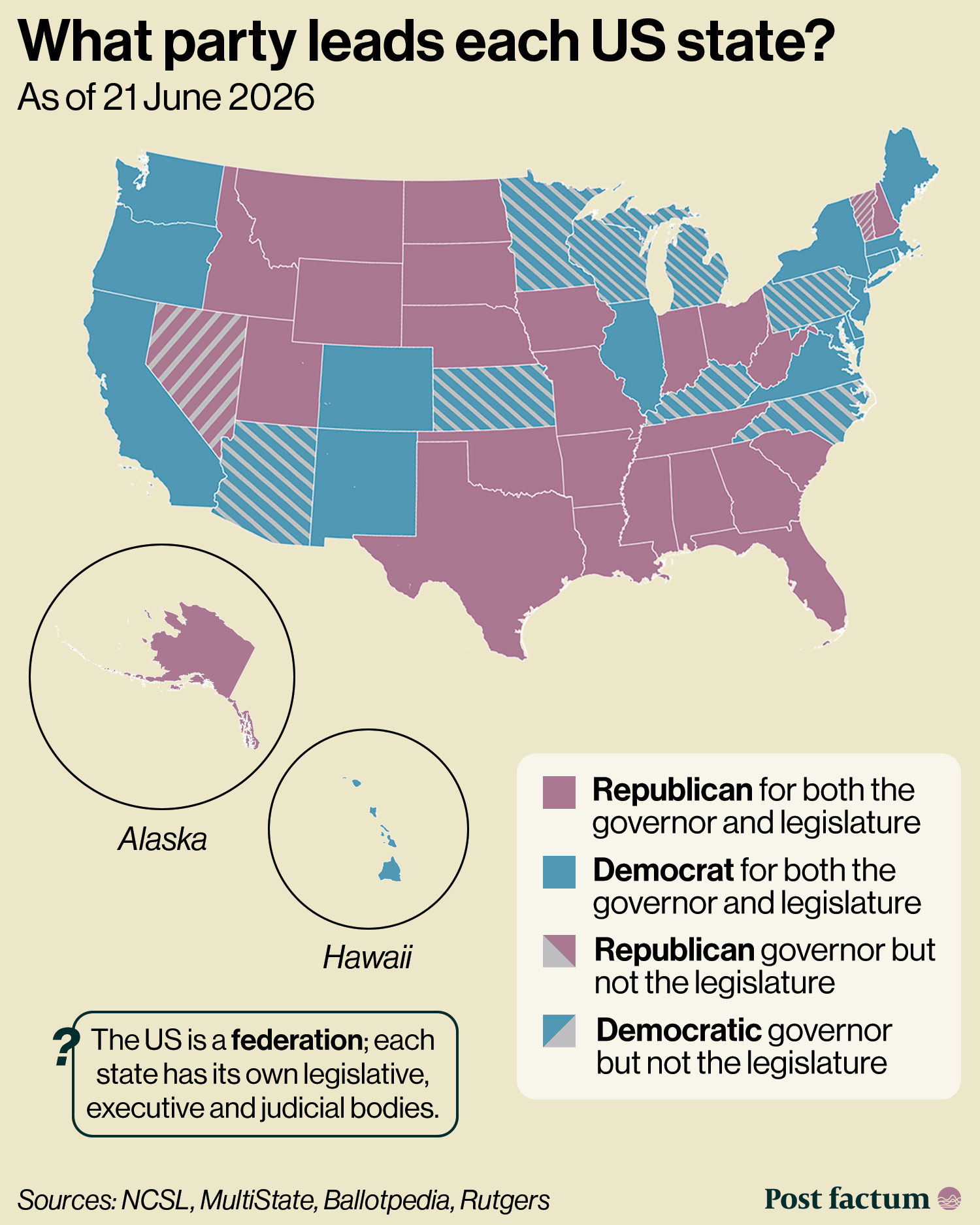
Vertically: the US is a federation, where 50 states have their own legislative, executive and judicial institutions that govern them.
Checks and balances is the principle that each branch of government can block or restrain the others, so that no single one holds all power.
The President can block (veto) laws, Congress confirms appointments and can sanction officials, and courts can rule laws unconstitutional.
Interest groups (lobby groups) promote their preferred policies to lawmakers, provide arguments, data and draft laws (bills).
Over $5 billion was spent on federal lobbying in 2025, with around 13,000 registered lobbyists.
Campaign finance is giving money to candidates, which can win political favours later. The amount that can be given is limited by law.
Since 2010, if the money is spent in support of a candidate but formally without their involvement, the spending is unlimited; this is called a Super PAC.
Federal agencies write detailed regulations that carry the force of law, adding details and specifics to the broad laws passed by Congress.
For example, the Food and Drug Administration (FDA) controls medicines and food products, while the Federal Bureau of Investigation (FBI) is the security service with broad law enforcement powers.
The Federal Reserve (Fed), the country's central bank, was made independent of the President and Congress on purpose.
Its goal is to control general prices by changing the cost of borrowing from banks.
Other independent agencies exist, especially around finance, elections, energy, free markets and communications.
Congress has two chambers: the House of Representatives (435 members) and the Senate (100 members).
In the House, each state receives seats based on its population size.
Each state is guaranteed at least 1 seat, making votes in a low-population state like Wyoming relatively more influential.
The entire House is re-elected every 2 years.
This happens at the same time as the presidential election, plus an extra time halfway through a President’s term (midterms).
The President’s party has lost House seats in 40 of 43 midterms since 1842.
In the Senate, each state gets 2 seats, regardless of size.
Each Senator serves a 6-year term, with 1/3 of the Senate re-elected every 2 years.
Since the 1850s, one of 2 parties has won the congressional elections: the Democrats or the Republicans.
They have changed their ideology and policies over time.
In theory, any party can win, but (1) it is expensive and (2) the seats are not allocated proportionally, so a majority is needed for representation.
The President is elected indirectly through a system called the Electoral College.
Each state gets a number of electors equal to how many seats the state has in the Senate and the House, combined.
A popular vote in each state decides who the state’s electors will vote for.
This was designed in 1787 as a compromise between election by Congress and a direct popular vote.
5 times in history the elected President would have lost in a direct popular vote.
In 2016, Donald Trump won the electoral vote 304-227 while Hillary Clinton won the popular vote by 2%, or 3 million votes.
State and local elections (for governors and lawmakers) run on their own cycles, meaning there are many local elections every year.
Federalism, explained
In a federation, power is shared between the central and regional governments, unlike a unitary state (where the centre holds all power) or a confederation (where the states do).
In the UK, for example, local power is given by the centre and can theoretically be removed.
The Constitution gives the federal government specific (enumerated) powers such as defence and foreign policy, and reserves the rest to the states, including education, health and criminal law.
Both levels of government can also tax, borrow and run courts.
The Supremacy Clause: where federal and state law conflict, federal law wins.
The Commerce Clause gives Congress the power to regulate interstate trade.
It has been used broadly since the 1930s to cover most economic activity.
In 1942, the Supreme Court ruled that even wheat grown for personal use on one farm fell under federal regulation, because in total such activity affects the interstate market.
Presidential power has grown over the past century, with the largest expansions in the 1930s, during the Cold War and after the 2001 terror attacks on the US.
Presidents now use executive orders, emergency powers and executive agreements to act without new law passed by Congress.
Party loyalty now regularly overrides institutional loyalty: members of the President’s party in Congress defend the party’s interest more than their chamber's powers.
The federal government attaches conditions to the money it gives to the states to influence policy.
Federalism produces policy differences between states: cannabis, abortion, the death penalty and minimum wages all vary by state, in what is called the ‘laboratories of democracy’.
How laws are passed
Only members of Congress can propose a new law (called a bill), and the process from proposal to law involves several stages.
Introduction: a member of the House or Senate formally presents the bill, with revenue-raising bills required to start in the House.
Committee review: the bill goes to a committee with authority over its subject, which holds hearings, reviews the text and votes on whether to send it forward.
Voting: a bill needs to pass each chamber by simple majority, but reaching a Senate vote often requires 60% to overcome the filibuster.
The filibuster: in the Senate, any Senator can extend debate indefinitely to block a vote, and ending this requires 60 out of 100 votes.
Conference committee: if the two chambers pass different versions, a joint committee negotiates a single text that both must accept or reject in full.
Presidential action: the President has 10 days to sign the bill into law, block (veto) it, or let it become law without a signature.
Veto override: Congress can override a veto with a two-thirds vote in both chambers. Historically around 7% of vetoes have been overridden.
In practice, most bills die in committee debates without reaching a floor vote in any chamber.
Thank you for reading!
Join Post factum Pro to see the comment section below.