
Nord Stream Explosions, revisited
20 September 2026
- A Ukrainian team placed the underwater charges, German prosecutors say.
- Russian hybrid operations and NATO’s response have both intensified since.
- Liquefied gas from the US and lower demand replace Russian imports.
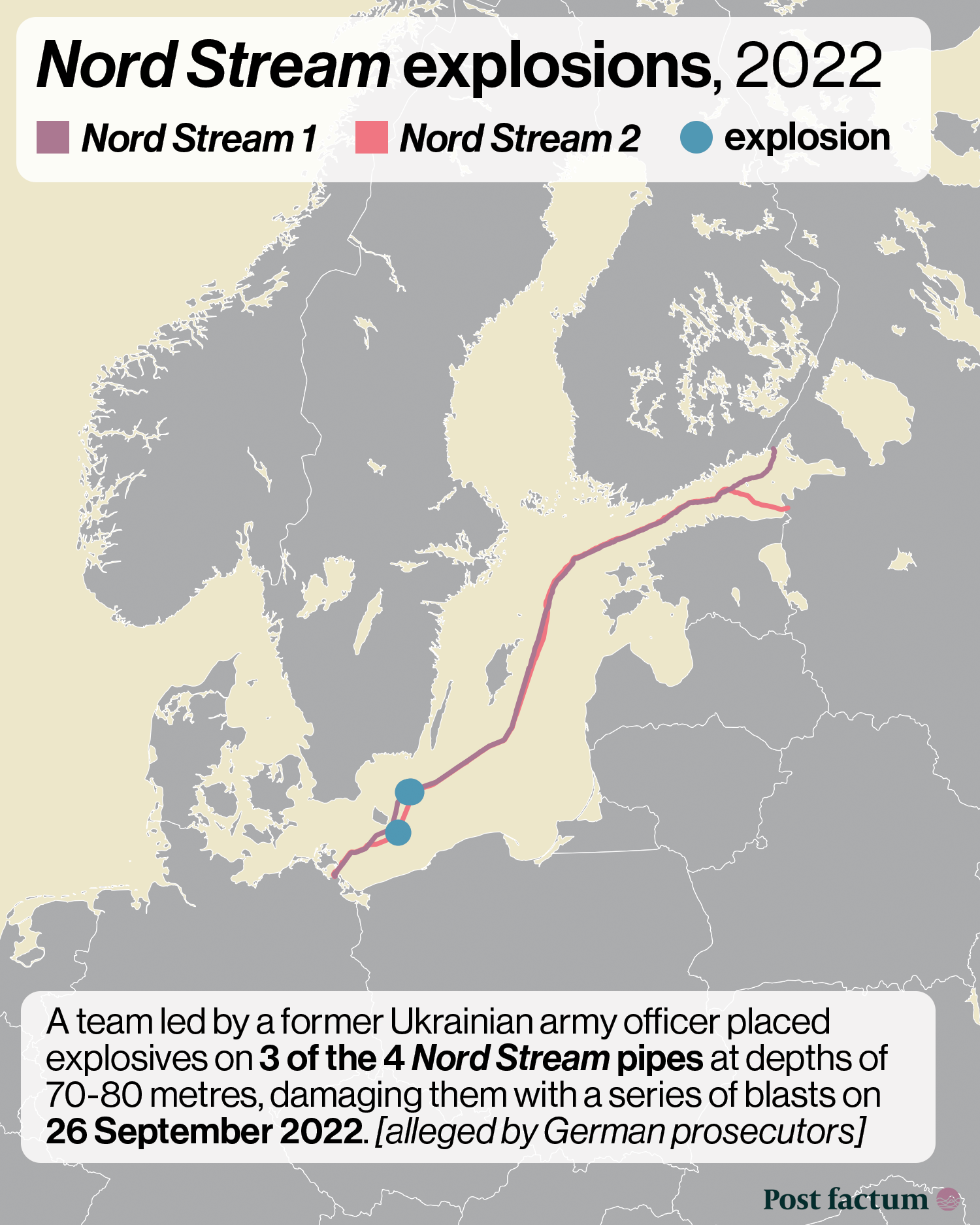
On 26 September 2022, underwater explosions damaged 3 of the 4 Nord Stream gas pipelines between Russia and Germany.
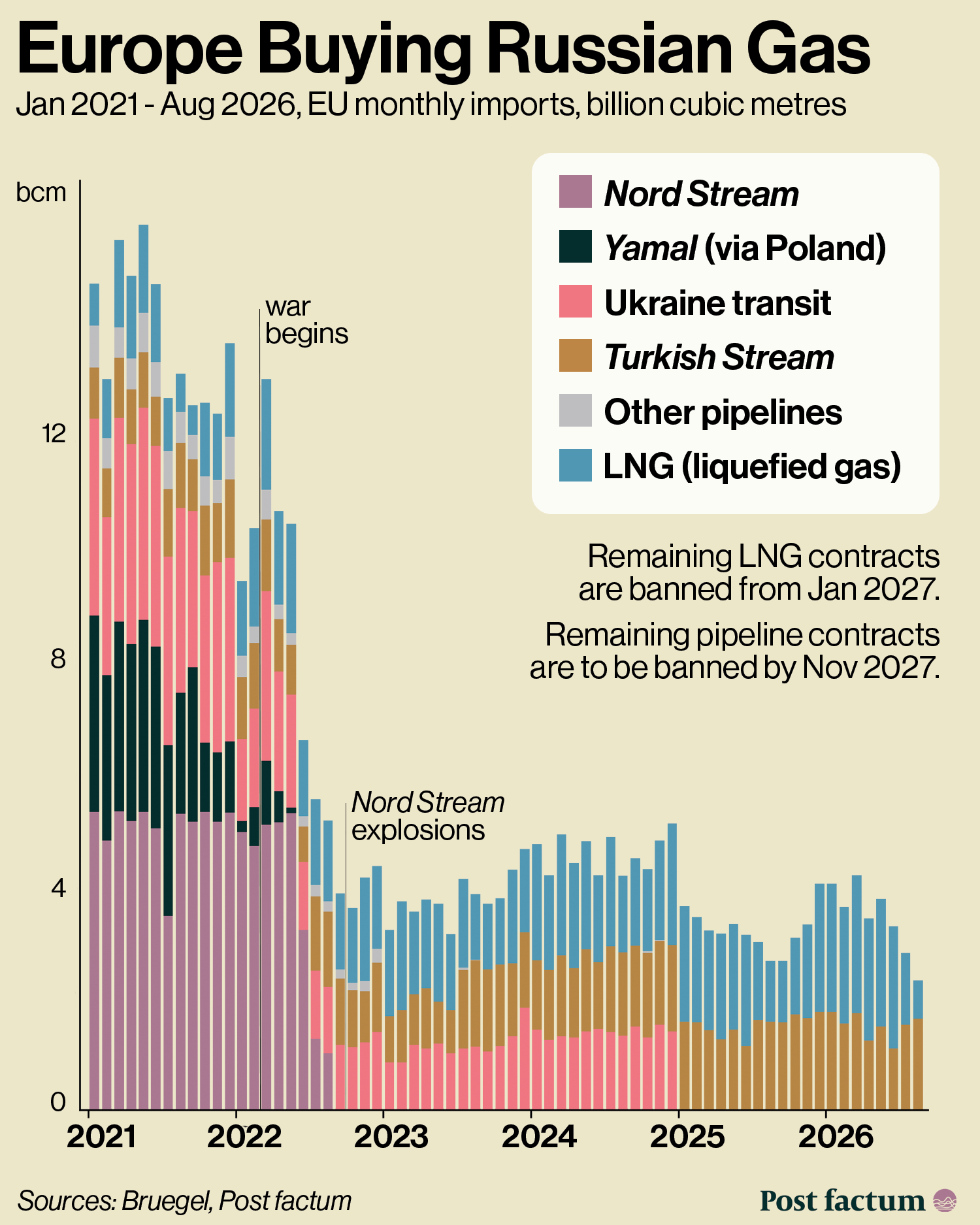
Nord Stream 1, a pair of pipelines, carried 17% of EU gas imports in 2021 (25% of Russian gas exports).
Nord Stream 2, the second pair, was completed in 2021 but never carried commercial gas: Germany halted approval days before Russia invaded Ukraine.
Germany backed the pipeline project from 2005 as a direct route to the supplier, Russia.
- Cheap energy from gas contributed to the success of German industry.
- Some European politicians also believed that trade with Russia would keep it politically closer.
Nord Stream was an alternative to the route through Ukraine and Poland, which opposed it, as did the US (with sanctions in 2019).
No gas was flowing when the blasts came: Russia had stopped pumping gas through Nord Stream 1 by September 2022, tying a restart to sanctions relief.
The lines were still filled with pressurised gas, releasing up to 485,000 tonnes of methane, a record leak, equal to 2 days of global oil and gas industry methane emissions.
Who did it, and how?
German prosecutors say a group led by a former Ukrainian army officer rented a small yacht in Germany under false identities and placed timed explosives on the connectors between segments of the pipes.
- 1 of 4 pipelines survived intact, likely because of a mistake made by the divers.
- The explosives were placed 70-80 m deep and weighed 14-27 kg each.
The accused officer will go on trial in Germany in October 2026, and a second suspect, a diver, awaits a surrender ruling in Croatia.
The Ukrainian government denies directly authorising the attack.
Repair, restart?
Seawater rushed into the 3 damaged pipelines, leading to corrosion and further damage.
Currently, estimates put repairs at around $1.5 billion, but political opposition and EU laws present a bigger challenge.
Denmark allowed the Russian state gas company in January 2025 to plug the open ends of the single damaged Nord Stream 2 line, to stop further environmental damage.
- Surveys and underwater work took place in July 2025, but no report confirms the plugs are in place.
An English court ruled that insurers do not need to pay $650 million to the owner of Nord Stream 1, as its policy excluded war damage.
The surviving line could potentially run again without repairs.
- Germany refused Russia’s October 2022 offer to send gas through it.
- A potential US investor put repairs to Nord Stream 2’s second line at under $700 million.
- The capacity of each of the 4 pipes was 27.5 bcm (billion cubic metres).
EU sanctions have banned any transaction to use either pipeline pair since July 2025.
Germany’s current chancellor has pledged to keep Nord Stream 2 closed, but the AfD party, which currently leads the polls in Germany, promised to restart the pipeline.
How is the EU ending Russian gas?
Europe did not completely stop buying Russian gas and is still importing some of it.
- This includes LNG (liquefied natural gas, shipped by tankers).
Ukraine ended transit in January 2025 by letting the contract (signed in 2019) run out.
The last active pipeline route goes through Türkiye, covering under 20% of pre-war imports but most of the demand from Hungary.
An EU law adopted in January 2026 bans remaining imports in stages: short-term contracts ended in April 2026 for LNG, and in June for pipeline gas.
Long-term contracts remain for pipeline gas in Hungary, Slovakia and Greece, and for LNG delivered to France, Spain, Belgium and the Netherlands.
Russian LNG sales to the EU remained stable between 2021 and 2025.
Overall, the EU reduced Russian imports by 76% between 2021 and 2025.
Who supplied instead?
Firstly, the EU reduced its imports of gas by 15%, covering around 40% of lost Russian imports.
Most of the remainder was supplied by the US (as LNG), and around 9 bcm extra by Norway.
The shift to LNG
LNG rose from under 25% of EU gas imports in 2021 to 45% in 2025 (131 bcm), 58% of that from the US.
LNG needs specialised import terminals and other infrastructure.
The EU added 76 bcm of yearly LNG import capacity between 2021 and 2025, and Germany, which had no terminals before December 2022, now has 4.
The EU swapped dependence on one pipeline supplier for exposure to the world LNG market, where cargoes go to the highest bidder.
20% of world LNG trade passes through the Strait of Hormuz.
- Qatar, a major LNG exporter, shipped 18 cargoes in the 6 months since the start of the Iran War, against 509 a year earlier.
The cost, 4 years on
European governments set aside $703 billion between September 2021 and January 2023 to support energy consumers, 25% of it in Germany.
- Germany’s energy-intensive output fell 15% between February 2022 and March 2026.
Russian oil and gas revenues fell to 23% of the budget, from 50% 10 years earlier; its gas piped to China in 2025 amounts to a quarter of Russia’s 2021 EU sales.
Gas prices
Europe’s gas price averaged $26 per megawatt-hour in the first half of 2021 and reached a record $339 in August 2022.
It averaged $41 in 2025 and closed at $95 on 14 September 2026, the highest since December 2022.
How did Europe cut its gas use?
EU gas use in 2025 was 17% below its 2019-21 average.
A study of the winters up to 2024 attributes 29% of the fall to households heating less, 25% to lower industrial output, 11% to warmer winters and 10% to renewable electricity.
Wind and solar produced 30% of EU electricity in 2025, up from 20% in 2020.
Sabotage and responsibility
No court or international body has held any state responsible, and courts in 2 EU states have split:
- Germany: the top criminal court ruled in 2025 that the pipelines were civilian assets, and that intelligence-directed violence has no immunity; proceedings are going ahead.
- Poland: in 2025, a court refused to give up the diver, who is now held in Croatia, ruling that such an attack in “a just, defensive war” is no crime.
Russia has intensified its hybrid war on Europe since 2022, which we analysed in a separate Pro report.

NATO’s response
NATO called the blasts an act of sabotage, then set up a coordination cell (2023) and a maritime centre for undersea infrastructure security (2024).
NATO’s Baltic Sentry mission, launched in January 2025, patrols the sea with warships, aircraft and, most recently, air, sea and underwater drones.
Seabed cables
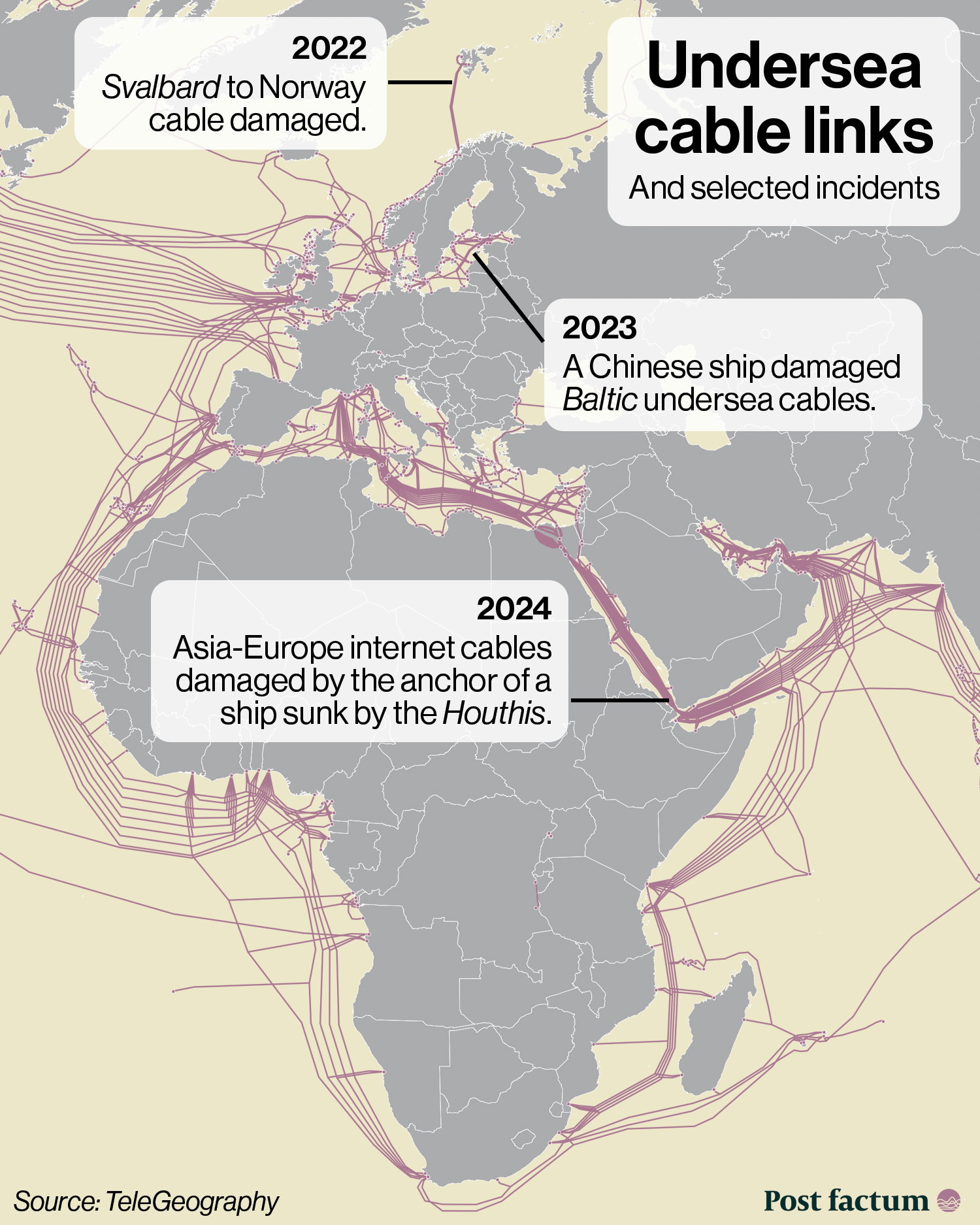
Over 600 undersea communications cables are active, carrying 99% of the world’s intercontinental data.
Around 200 faults happen per year, most from fishing gear and anchors.
Baltic Sea incidents since 2023 include:
- October 2023: a Chinese-owned container ship’s anchor broke a Finland-Estonia gas pipeline and 2 telecom cables.
- December 2024: a shadow-fleet tanker (an ageing ship with hidden owners carrying sanctioned Russian oil) cut a power cable and 4 telecom cables.
- December 2025: a cargo ship sailing from Russia damaged 2 cables with its anchor.
No Baltic case has produced a criminal conviction or a finding of intent.
Western officials said in January 2025 they had no evidence the earlier ships acted deliberately, which Finnish officials dispute.
Beyond 12 nautical miles from shore, the law of the sea generally leaves prosecution to a ship’s state of registration, not necessarily that of its ultimate owner.
A Finnish appeal court ruled in August 2026 that Finland can try the tanker’s officers; the ruling is not final.
Thank you for reading!
We need your help to survive
Post factum is independent and reader-powered.
We have to reach 5,000 Pro members to cover our costs and continue publishing, or the funding we have raised so far will run out.
Please help us hit this goal and keep bringing you high-quality factual reporting.
Join as a Founding Member and get all our past and future content at the best rate.
Your fee will go towards paying our staff and running our digital systems.
Keep exploring:


This week on Post factum Pro:

Join Post factum Pro to access the comment section.