
Oil Refining, explained
The Geopolitics of Processing Crude
11 August 2026
31% of all energy used by humans comes from crude oil and oil products.
Oil products are mostly fuels: 45% of all oil is turned into petrol (gasoline).
Another 25% makes diesel fuel, and around 10% — jet fuel (kerosene).
These fuels power most of the cars, trucks, tractors, planes and ships globally.
Also, 90% of basic materials used for making any chemicals come from crude oil.
These are needed for plastics, medicines, fertilisers and more.
- The world uses 100 million barrels of oil per day (1 barrel = 159 litres).
Crude oil needs to go through a complex and expensive refining process to make fuels or other products.
At its simplest, refining involves heating up the crude oil to separate different components that boil at different temperatures.
- This is called distillation and the products are called fractions.
Crude oil is extracted as a thick black liquid that is mostly a mix of hydrocarbons (molecules with different numbers of carbon and hydrogen atoms).
“Short” hydrocarbons (like butane) turn to gas easily, while “long” hydrocarbons (like asphalt) stay liquid even at high temperatures.
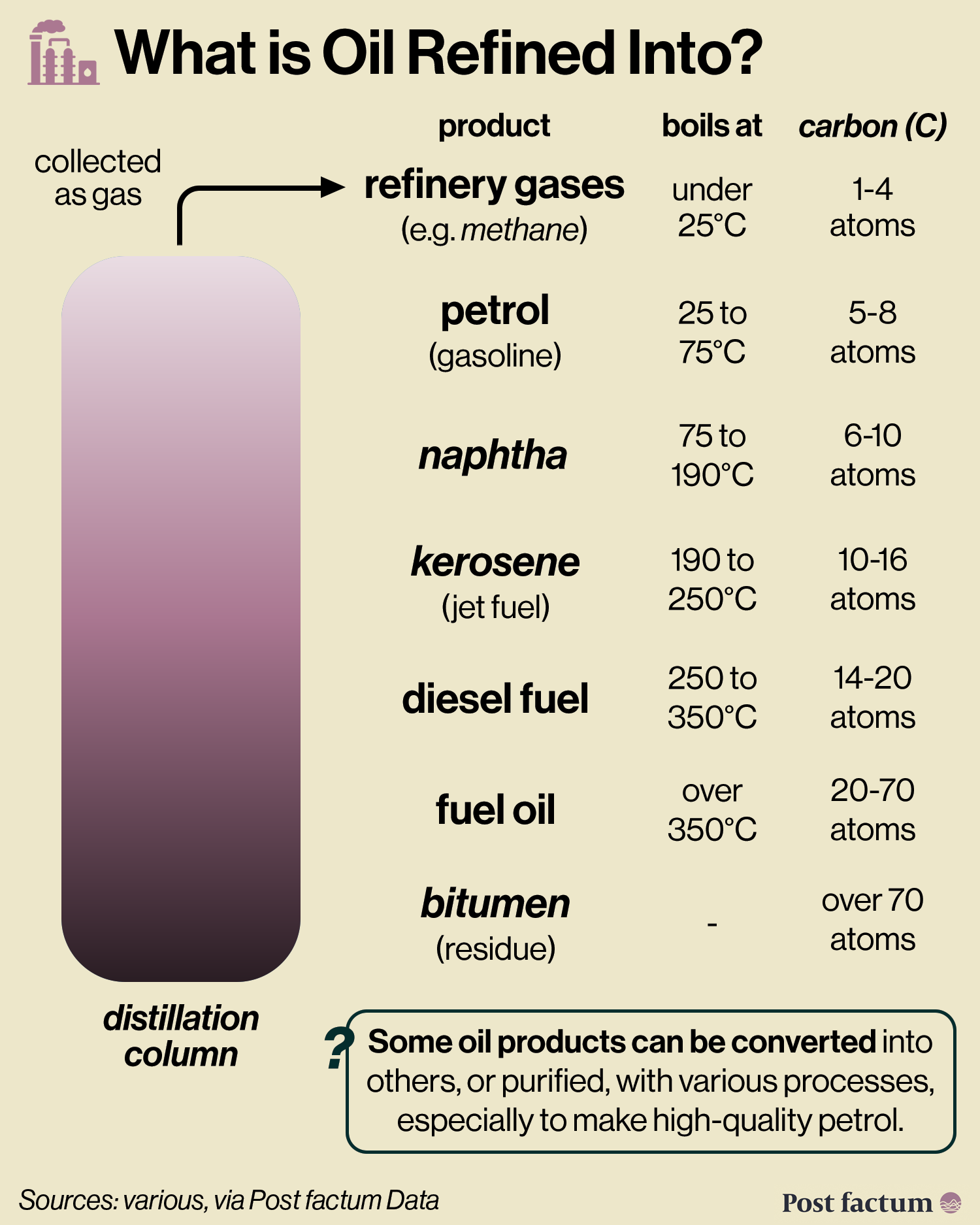
An oil refinery is a large industrial complex that includes a distillation column, as well as other equipment and storage tanks, for processing crude oil into fractions.
After the first separation, the fractions are processed further: to make them cleaner and purer, or to convert them into more valuable fractions, especially high-quality petrol.
Cracking is a process of breaking up “longer” hydrocarbons into smaller, more valuable molecules.
Heavy oil fractions like fuel oil are combined with a catalyst under heat and pressure to create lighter fractions like diesel or petrol.
- The catalytic cracking unit is often the most expensive and complex part of the oil refinery.
Many other chemical processes are used to convert various oil fractions, from naphtha to heavy fuels, into petrol components.
The crude oil itself differs by type:
- Heavy oil contains more “long” hydrocarbons than light oil.
- Sweet oil has less sulphur than sour oil.
The lightest and sweetest crude oil is extracted in Malaysia and Algeria.
Refineries are designed for specific sources of crude oil and cannot easily switch to types that differ by sulphur content or gravity, unless this flexibility was built in.
Oil refineries are regularly targeted in military conflicts, including the wars in Ukraine and Iran.
- During the Second World War, the US and the UK targeted German refineries in Romania and plants making aircraft fuel.
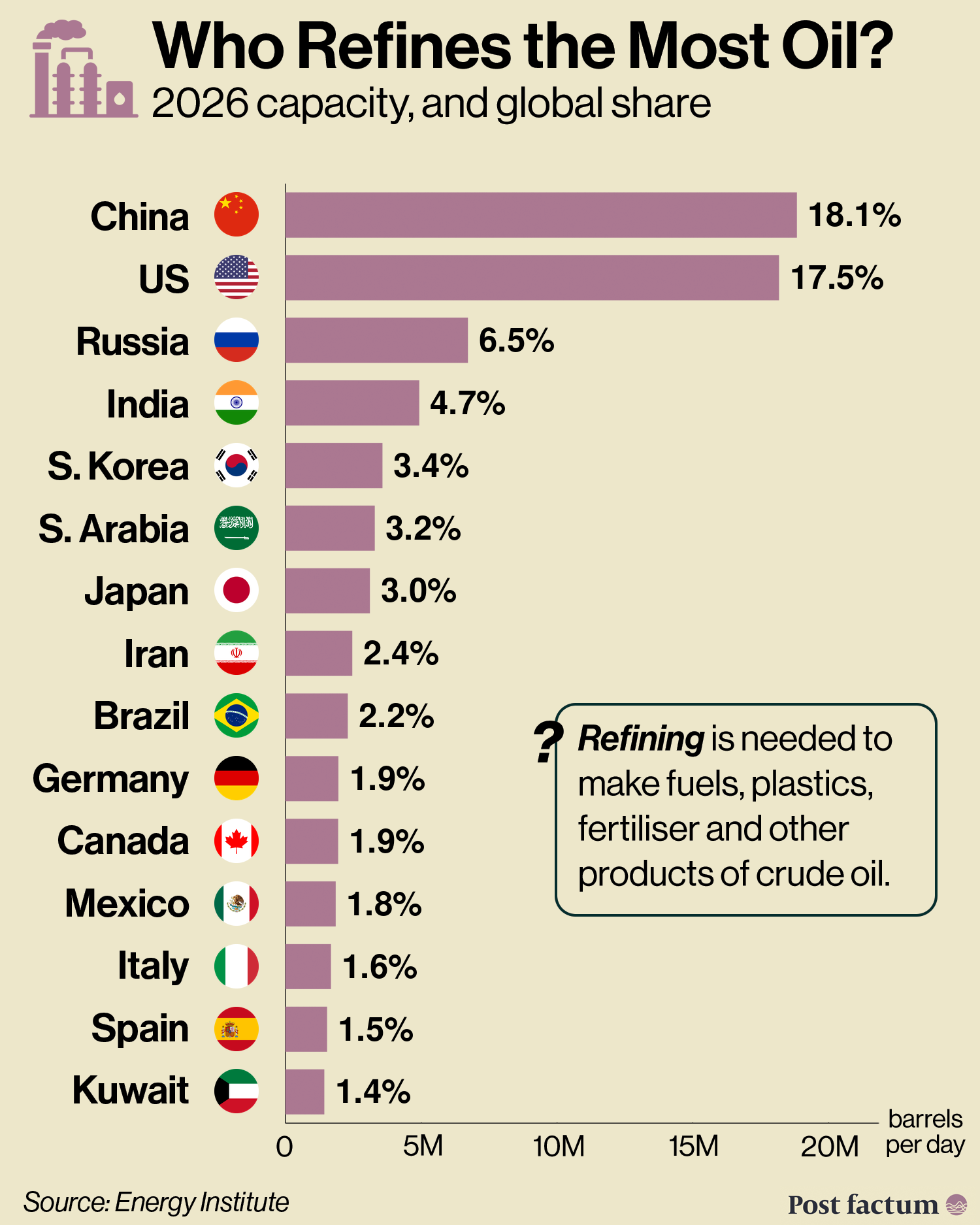
In 2015-2026, 59 refineries opened and 83 closed, shifting capacity from Europe and the Americas to Asia, Africa and the Middle East.
The newer refineries tend to be larger and more effective at processing crude.
In 2026, oil products are in a bigger deficit than crude oil, as refining becomes the bottleneck of the global economy.
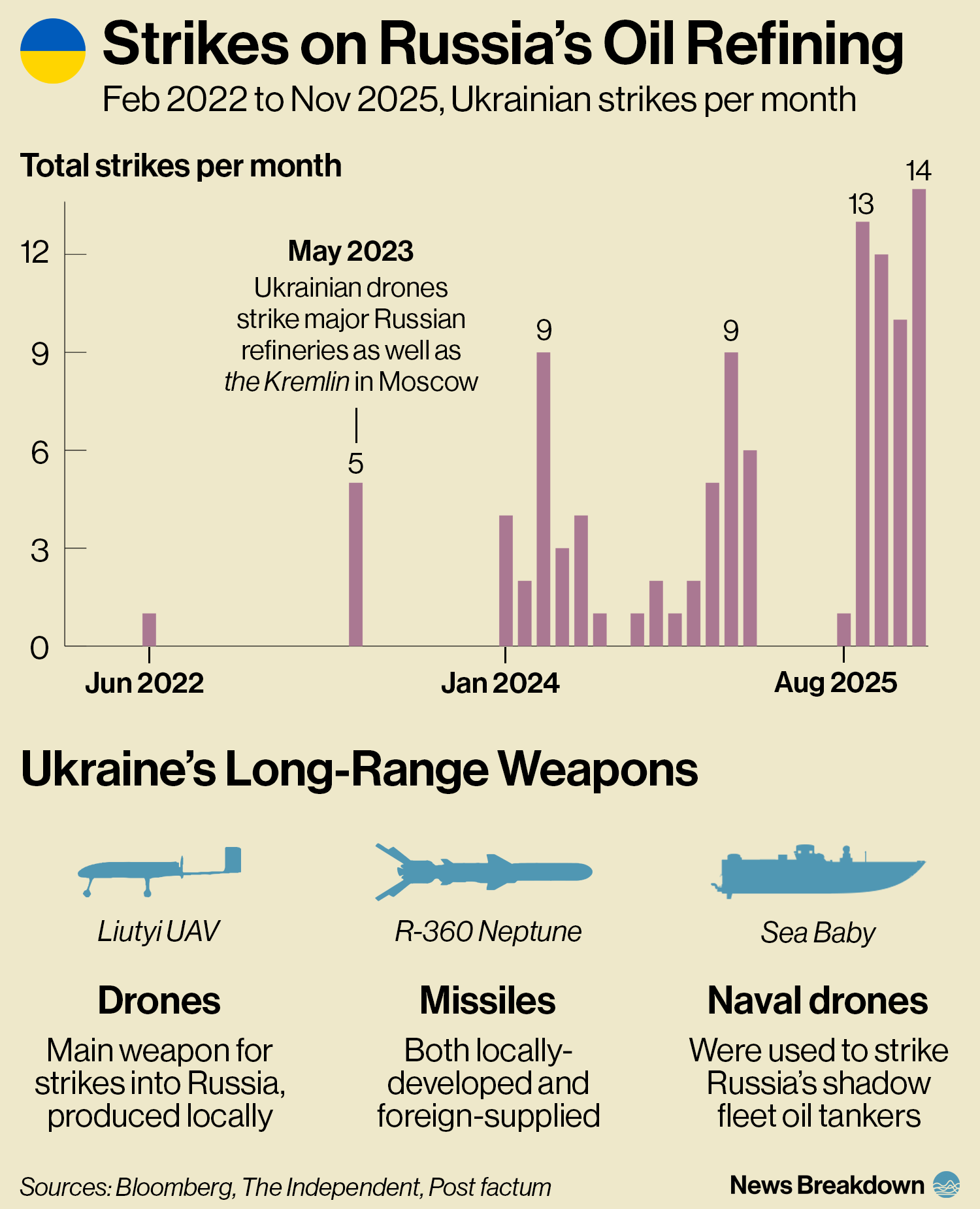
Ukraine struck all 10 of Russia’s largest oil refineries and reduced its refining capacity by 30-40% at the campaign’s peak in July.
- Russia experienced a short-term fuel crisis but the situation has since stabilised in most regions, while Ukraine continues its strikes.
- Russia destroyed Ukraine’s own largest refinery early in the war, leaving it dependent on fuel imports.
The EU has been reducing its refining capacity over the past 20 years, including in 2024-25.
- The EU banned imports of Russian crude oil after the invasion of Ukraine in 2022, but it did not ban oil product imports until 2026.
- Imports of oil products from India fell 97% because of their Russian origin; flows from Türkiye also slowed.
- However, Europe still imported around $1 billion of oil products made from Russian crude in January-May 2026.
- Out of 49 tankers arriving in the EU from refineries processing Russian crude, 36 came from Türkiye and 6 each from Georgia and India.
- Russian crude oil is sold at a discount, which motivates some refiners to find ways to avoid reporting the oil’s origin.
The UK is down from 18 refineries in the 1970s to 4 in 2026.
The US has not opened a new refinery since 1977 although it expanded some of the existing ones.
- US refineries on the coast of the Gulf of Mexico were designed for heavy and sour Venezuelan oil.
- After the removal of Maduro, the US has increased its imports of Venezuelan oil.
- Canada exports most of its crude to the US for refining.
In the Middle East, oil producers are looking to expand their refining capacity, while existing refineries become targets for Iranian attacks on US allies in the region.
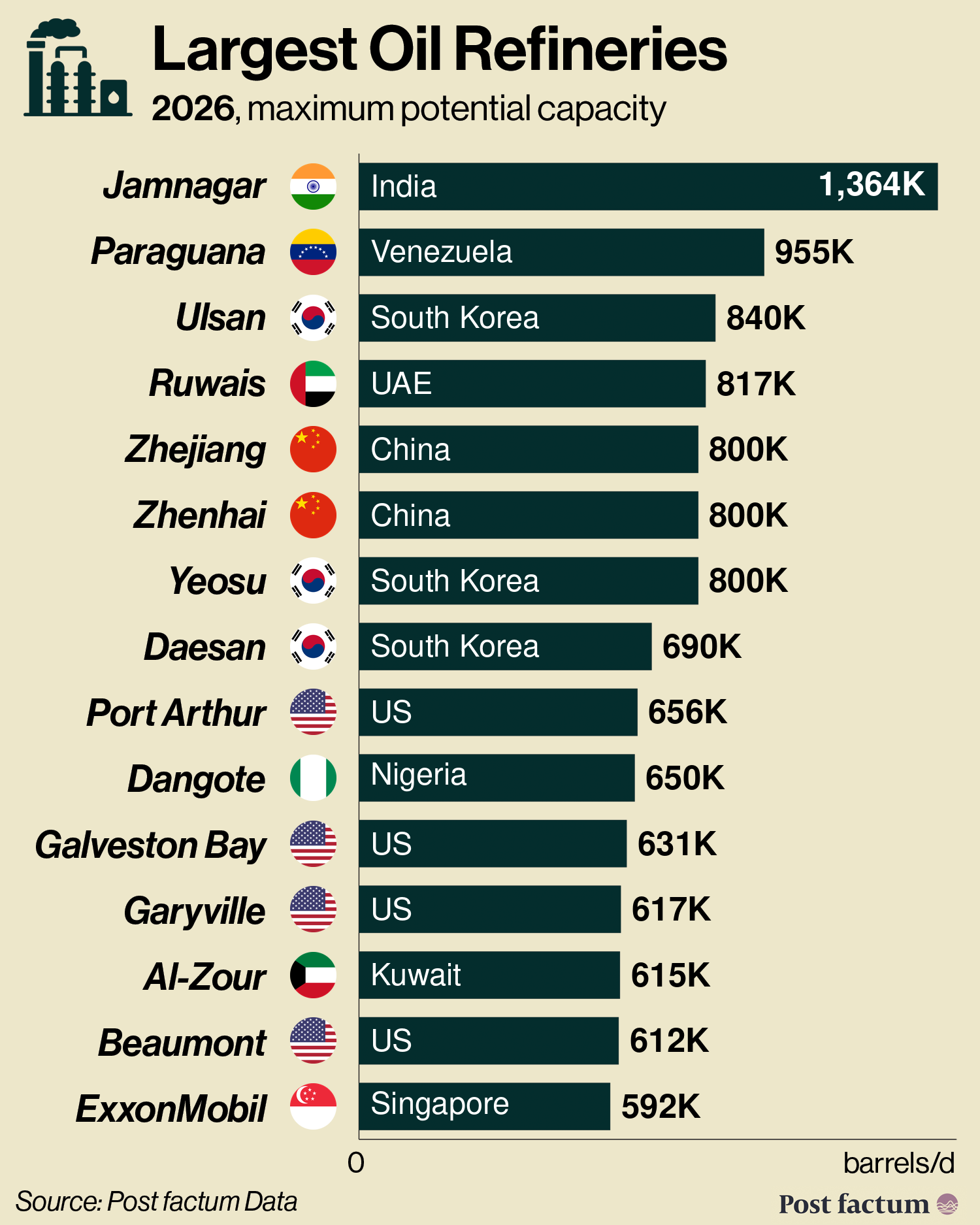
India’s Jamnagar is the world’s largest refinery and also the most complex, able to process 216 crude oil types.
China doubled its refining capacity in 20 years, now the world’s largest.
- China buys 90% of Iranian oil, avoiding sanctions by using shadow fleet tankers.
Nigeria, Africa’s largest oil producer, imported most of its fuel until the Dangote refinery opened in 2024.
- Dangote now meets 92% of Nigerian demand and keeps increasing capacity.
Venezuela has some of the largest refineries globally but they ran at a third of their full capacity for years, needing new investment.
Why did “the West” stop refining?
- Climate action: with falling demand for car fuel, and targets to reduce emissions and oil consumption, investors rarely approved new refining projects.
- Globalisation and efficiency: countries were willing to outsource the production of fuels and other oil products to the largest players globally, trading security for savings.
- De-industrialisation: this was also part of the broader decline in heavy industry due to lack of government support and high cost of labour, especially in the EU, the UK, Australia and New Zealand.
Thank you for reading!
Hey, curious mind! My name is Anton, I am the Founder of Post factum. Hope you enjoyed this report.
I started this project out of frustration with biased, opinionated, attention-grabbing news media filled with ads and placements.
Post factum alone cannot change the world; but we can share concise, factual, neutral, systematic, accessible and visual reporting, ad-free.
I ask you to think about supporting us by joining Post factum Pro if you find our work valuable.
On top of all the exclusive content, you get to support an independent, reader-powered outlet against the mainstream media juggernaut.
Keep exploring:

This week on Post factum Pro:
Join Post factum Pro to access the comment section.