
Milei’s Shock Therapy of Argentina
Explained in 5 Infographics
22 September 2026
Javier Milei became president of Argentina in December 2023, promising to end high inflation and reduce the government’s involvement in the economy.
For decades, the state often spent more than it collected and printed the local currency (pesos) to cover the gap, which pushed up prices (inflation).
- Inflation was 211% in 2023, the most since 1990.
Argentines preferred to convert their savings into US dollars, and the state limited how many they could buy.
Argentina has failed to repay its debts 9 times, and owes the IMF, a global lender to states in crisis, about $57 billion, more than any other country.
Milei’s “shock therapy” was to balance the budget within months and stop printing money to fund the state.
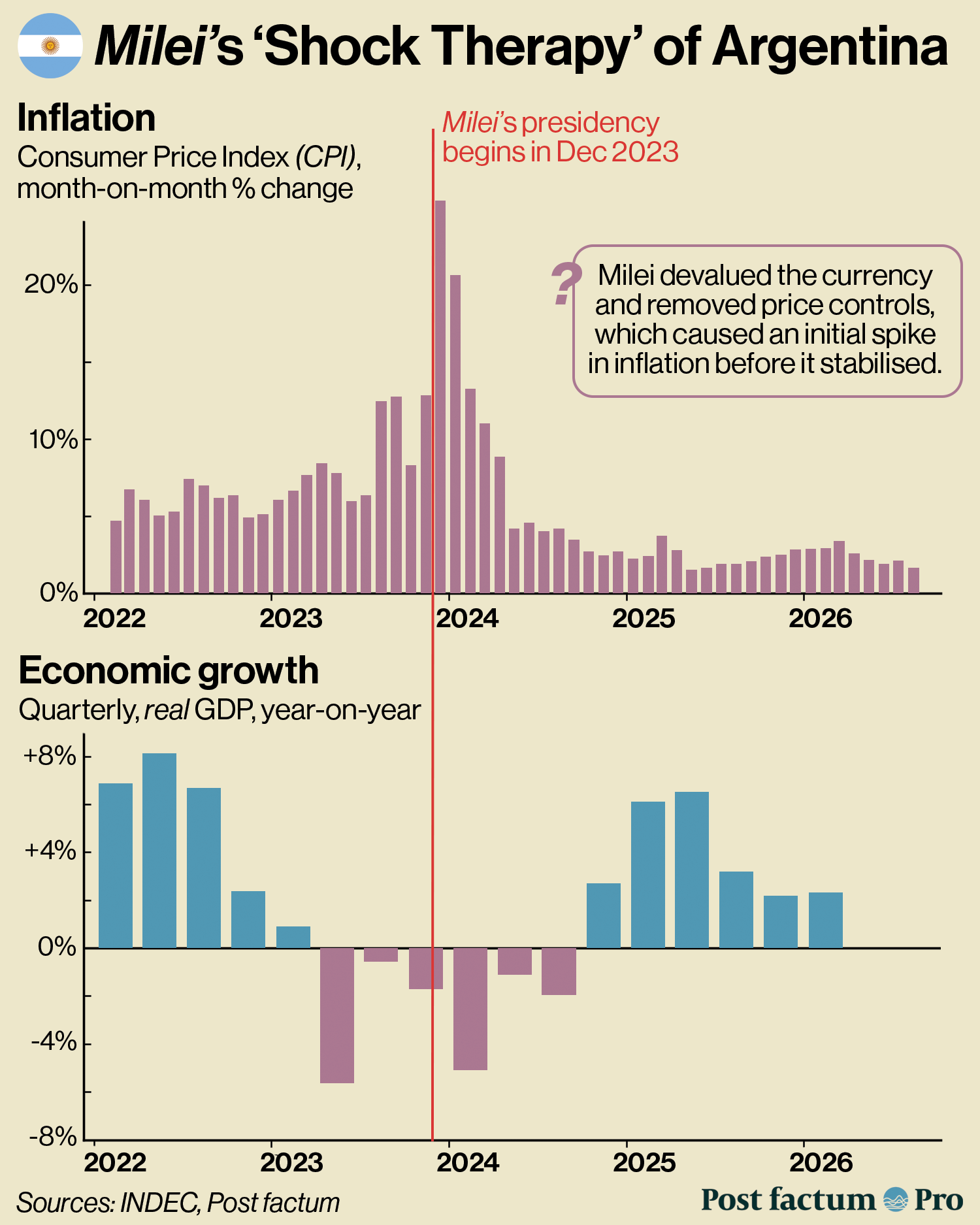
Inflation and growth
At first, monthly inflation doubled to 25.5% in December 2023, when Milei cut the peso’s official value by 54% and price controls ended.
Monthly inflation fell to 1.7% by August 2026.
- This projects to 22% yearly inflation (comparable countries target 2-6%).
Milei had earlier promised that monthly inflation would be below 1% by August 2026.
- Inflation across the globe has been pushed up by the war in Iran.
The economy (GDP) shrank by 1.4% in 2024.
It grew by 4.5% in 2025, led by the finance, mining and farming sectors.
- Growth of 2-4% is projected for 2026.
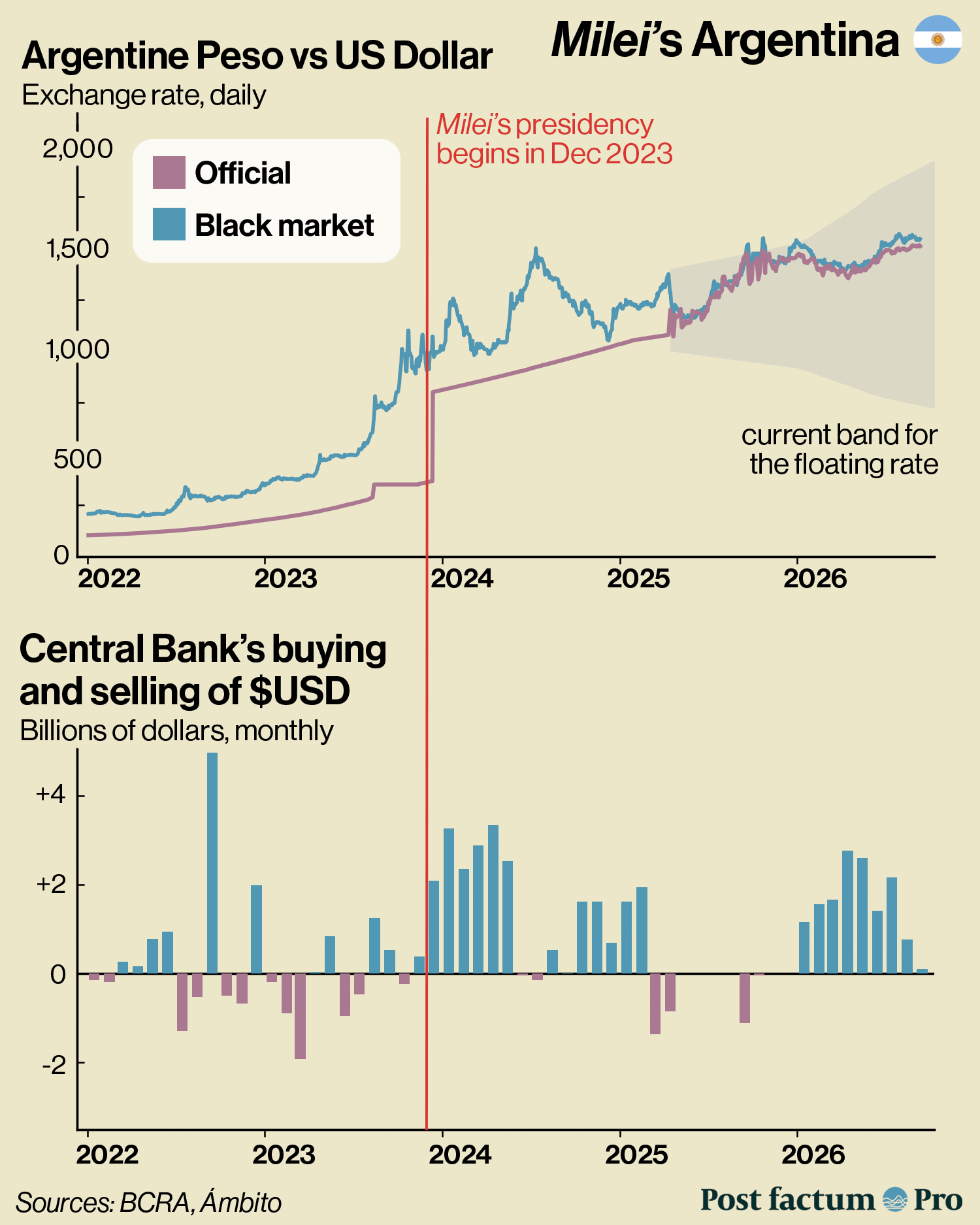
Peso and central bank
A black-market dollar cost 2.7 times the official price in November 2023; the gap is now about 2%.
Since April 2025:
- Individuals can buy dollars without a limit.
- The peso’s exchange rate is allowed to float freely inside a set range.
- The range is designed to expand with inflation and to result in a free-floating currency.
Before that, buying US dollars was capped at $200 per person per month.
After the controls ended, individuals bought over $23 billion in the first half of 2026, around $2,000 per buyer per month.
Companies are still banned from buying dollars, except to pay for imports or service their debt.
Argentine exports are the main source of incoming dollars, with the record-high oil output accounting for 43% of the trade surplus.
The central bank bought $19 billion for its reserves in 2024, almost nothing in 2025 and $14 billion so far in 2026.
In 2026 the official dollar rose by about 4% and prices by 21%, so Argentine goods became more expensive in dollars and imports became cheaper.
- The central bank created new pesos to buy these dollars but pulled out an equivalent amount from the economy through other instruments.
Reserves rose from $21.5 billion in November 2023 to about $50 billion, including money borrowed from China and the IMF.
Milei originally promised to close the central bank but has not, and a recently proposed law would instead ban it from lending to the government.
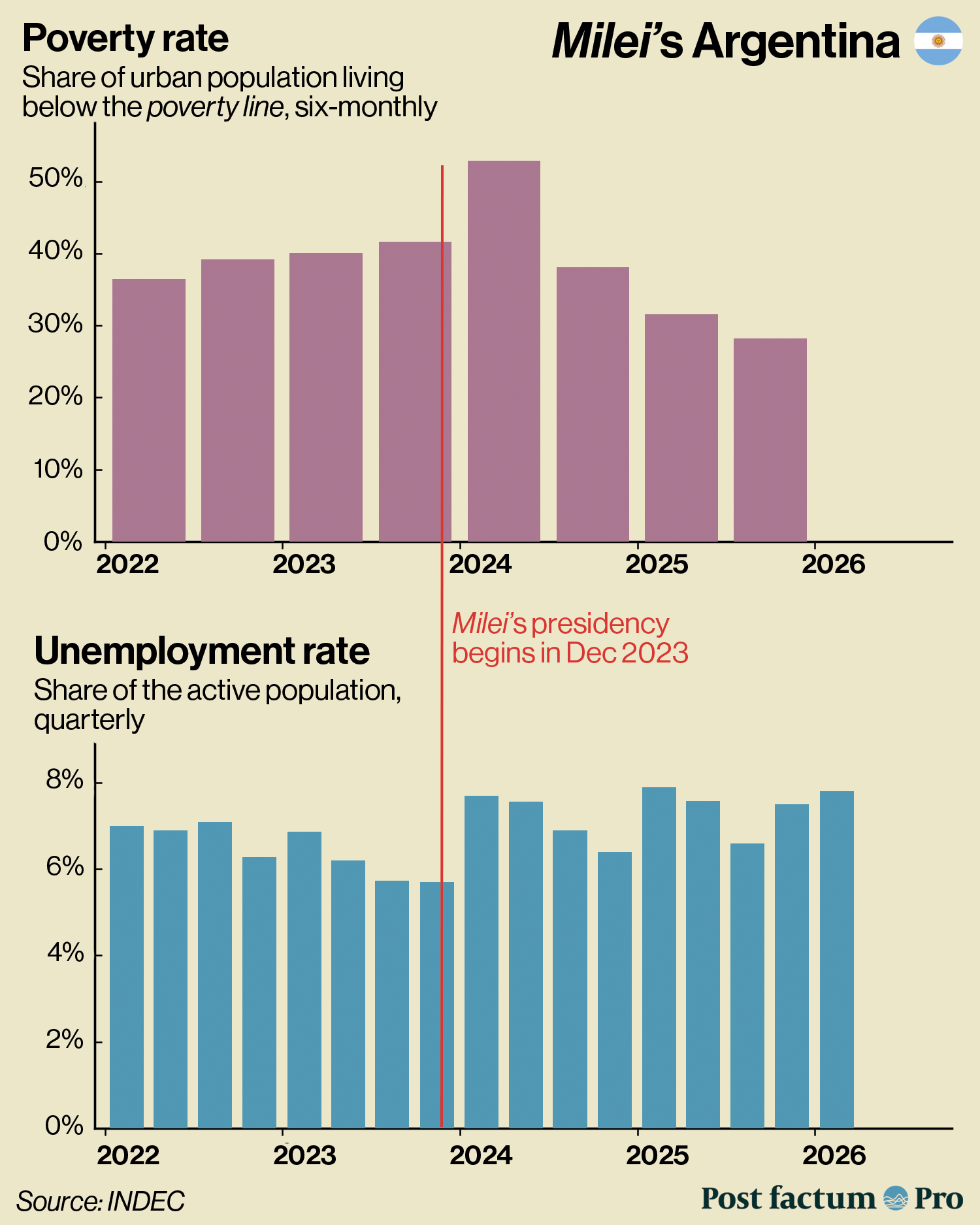
Poverty, jobs and pay
Poverty increased from 42% to 53% in the first half of 2024.
It fell to 28% by the second half of 2025, the lowest since 2018.
- Poverty here is the share of city residents with incomes below the cost of a basket of basic goods and services.
Unemployment was 7.9% in June 2026, up from 6.2% in 2023, and the type of work changed:
- Informal work, with no contract or pension payments, grew by 2% of the workforce.
- Formal employment decreased by 1%.
Average formal private pay buys about as much as in November 2023, but the minimum wage buys about 40% less.
Employment and wages are among the priorities for Argentine voters in 2026, according to polls.
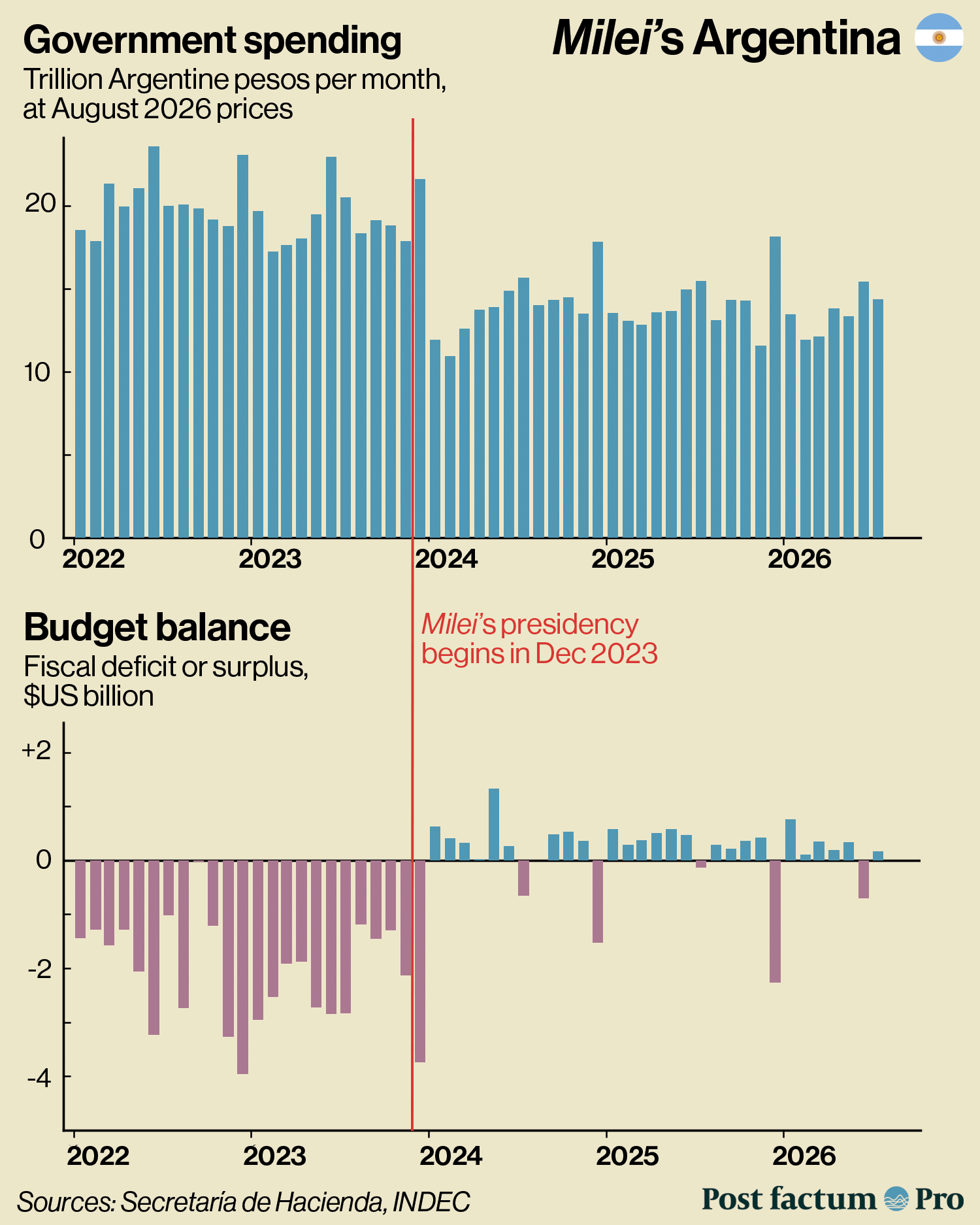
Spending and the budget
The national government now spends 28% less than in 2023 (adjusted for price increases) and employs 21% fewer people.
The number of ministries was cut from 18 to 8.
The largest savings came from (1) ending state support for energy and transport bills, as well as (2) cutting social aid and money sent to provinces.
Public spending, including provinces but not debt interest, fell from about 38% to 31% of GDP between 2023 and 2025, under half the cut Milei had promised.
In 2024, as promised, the national government spent less money than it collected (fiscal surplus) for the first time since 2010, and then again in 2025, by 0.2% of GDP.
Pensions are the largest item of state spending, about 45% of the total in the 2027 proposed budget.
Since April 2024, pensions rise each month in line with inflation, but the 70,000-peso ($46) bonus paid on top of the minimum pension has been frozen since March 2024.
The minimum pension with bonus buys 9% less than in November 2023, while pensions above the minimum buy 11% more.
Milei blocked laws raising pensions in 2024 and 2025.
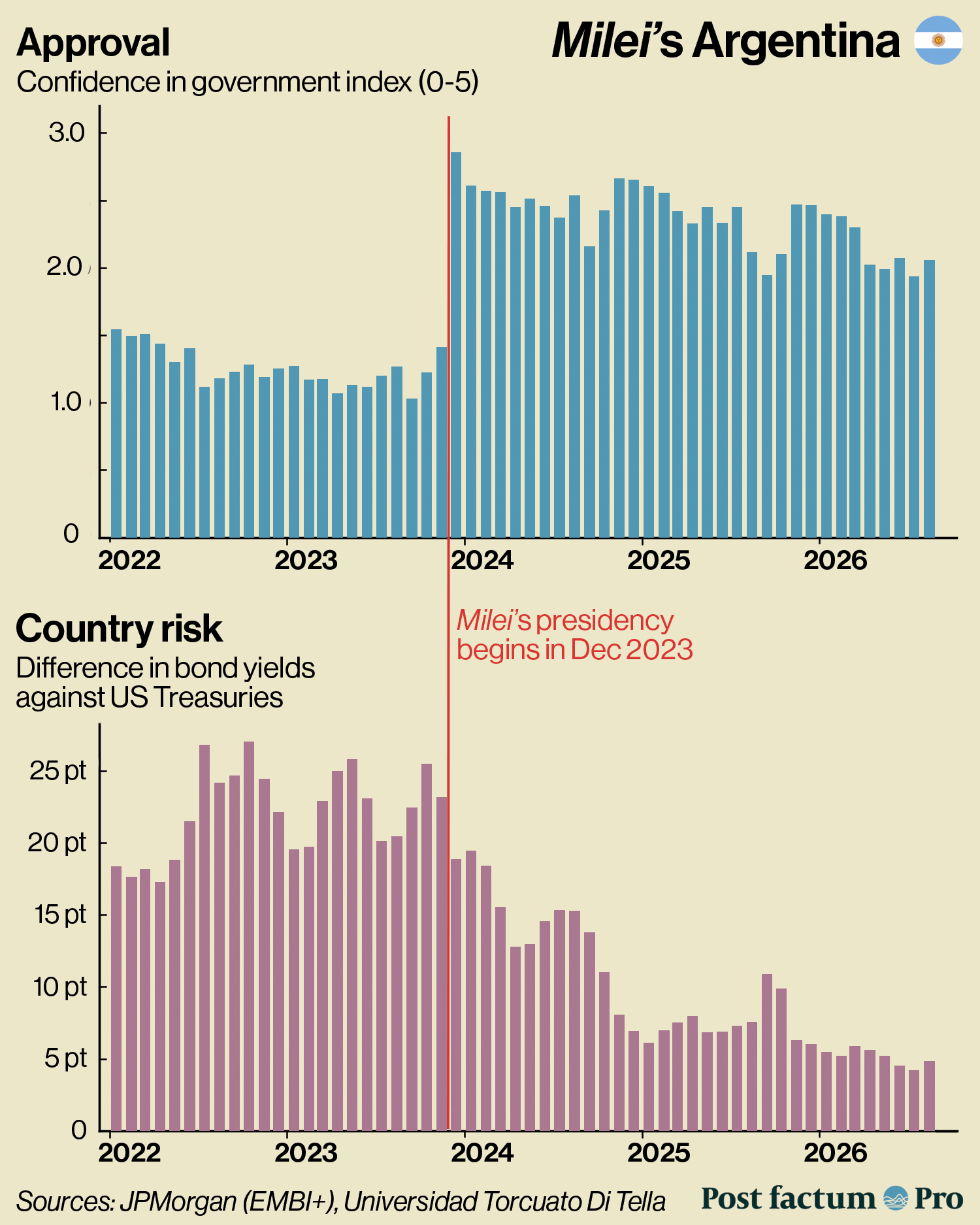
Approval and country risk
Trust in the government (scored from 0 to 5) rose from 1.41 to 2.86 in Milei’s first month, its peak, and was 2.06 in August 2026.
The low of 1.94 first came in September 2025, after bribery allegations at the disability agency and a lost election in Buenos Aires province.
Milei’s party then won the October 2025 parliamentary election with 41% of the vote.
Country risk fell from 23 percentage points in November 2023 to 5 in September 2026.
- Country risk is the difference between the cost of borrowing for a given country and for the US, measured as the difference between the interest rates charged (bond yields).
Argentina has not issued new dollar borrowing (bonds) on international markets since 2018.
In February 2025, Milei promoted a crypto-token which collapsed within hours, with investors losing $100 million to the “rug pull” scam.
Politics and geopolitics
Milei’s party started with 15% of lower-house seats in the parliament, and it now holds 37%, plus 29% of the upper house.
This allows it to block any unwanted laws but requires negotiations with other parties, especially provincial governors, to pass new laws.
Milei’s first budget passed in December 2025, and a labour reform that makes dismissing workers cheaper followed in February 2026.
Milei aligned Argentina more closely with the US, while also supporting Israel and the US-Israeli war on Iran.
The US government agreed to lend Argentina up to $20 billion days before the October 2025 election.
At the same time, Milei accepted a $20 billion credit line from China and supported pragmatic cooperation with it.
In 2026, Argentina took a harsher stance towards the Falkland Islands (a self-governing British overseas territory which the two countries fought over in 1982 and which Argentina claims).
- Argentina paused an oil project in the islands’ waters and set up sanctions to force companies to choose between developing Argentina’s oil fields and projects in Falkland waters.
More than $20 billion of dollar debt payments are due in 2027, when Milei plans to run for a second presidential term.
Milei is facing opposition from left-wing groups, especially over pensions and employment.
Thank you for reading!
Keep exploring:


