
Türkiye-PKK deal, explained
1 September 2026
- Kurdish fighters in Türkiye (PKK) agreed to disarm in May 2025.
- President Erdogan needs to extend his coalition of parties to be allowed to run in another election.
- The pro-Kurdish bloc makes up 10% of the Turkish parliament.
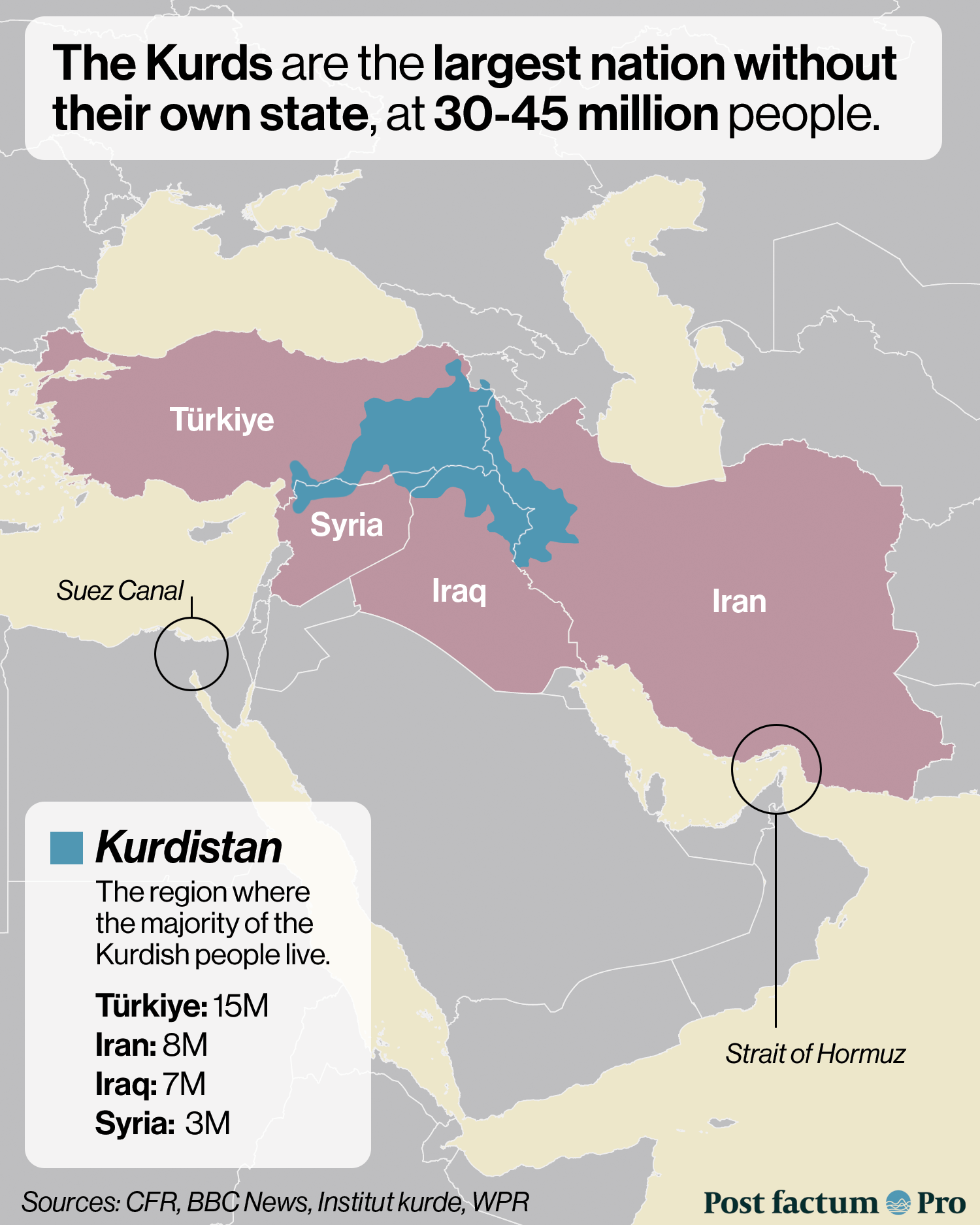
Kurds make up over 15% of Türkiye’s population, with around 15 million people.
Kurds in Türkiye have formed militant groups and fought the government since 1978, first for independence, later for autonomy.
This war killed over 40,000 people, including around 7,000 civilians.
- The conflict peaked in the 1990s after the war in Iraq provided Kurdish groups with a base of operations, with brutal tactics used by both sides.
- The PKK has been listed as a terrorist organisation by the EU, the US and the UK.
Active fighting restarted in 2015, after peace negotiations failed as Türkiye refused to support the defence of a Kurdish town from ISIS.
- Deaths: 4,876 PKK fighters, 1,513 Turkish soldiers, 655 civilians.
In 2024, Turkish President Erdogan’s coalition partner proposed to release the leader of the PKK, imprisoned since 1999, in exchange for the group disarming and disbanding.
In May 2025, the PKK voted to disband after its leader, Ocalan, called on the group to do so.
Why did the PKK agree to this?
- Military defeat: the group held no territory in Türkiye and suffered losses to cheap precision drone strikes.
- Erdogan’s push for another term: the support of pro-Kurdish parties in parliament may be needed to stand in another election.
- Syria: after the fall of Assad’s regime, the new government aligned with Türkiye and local Kurdish groups lost all territory in Syria.
The push for a 3rd term
The Turkish constitution limits presidents to 2 terms.
However, there are 2 ways to get around this:
- Amendment: changing the constitution to allow 3 or more terms. This needs 360 of 600 votes in the parliament and a popular referendum, or just 400 parliamentary votes.
- Early election: with 360 votes, an early election can be called, allowing a second-term president to run again.
By September 2026, Erdogan’s coalition holds 331 seats, with 3 independents recently joining his party.
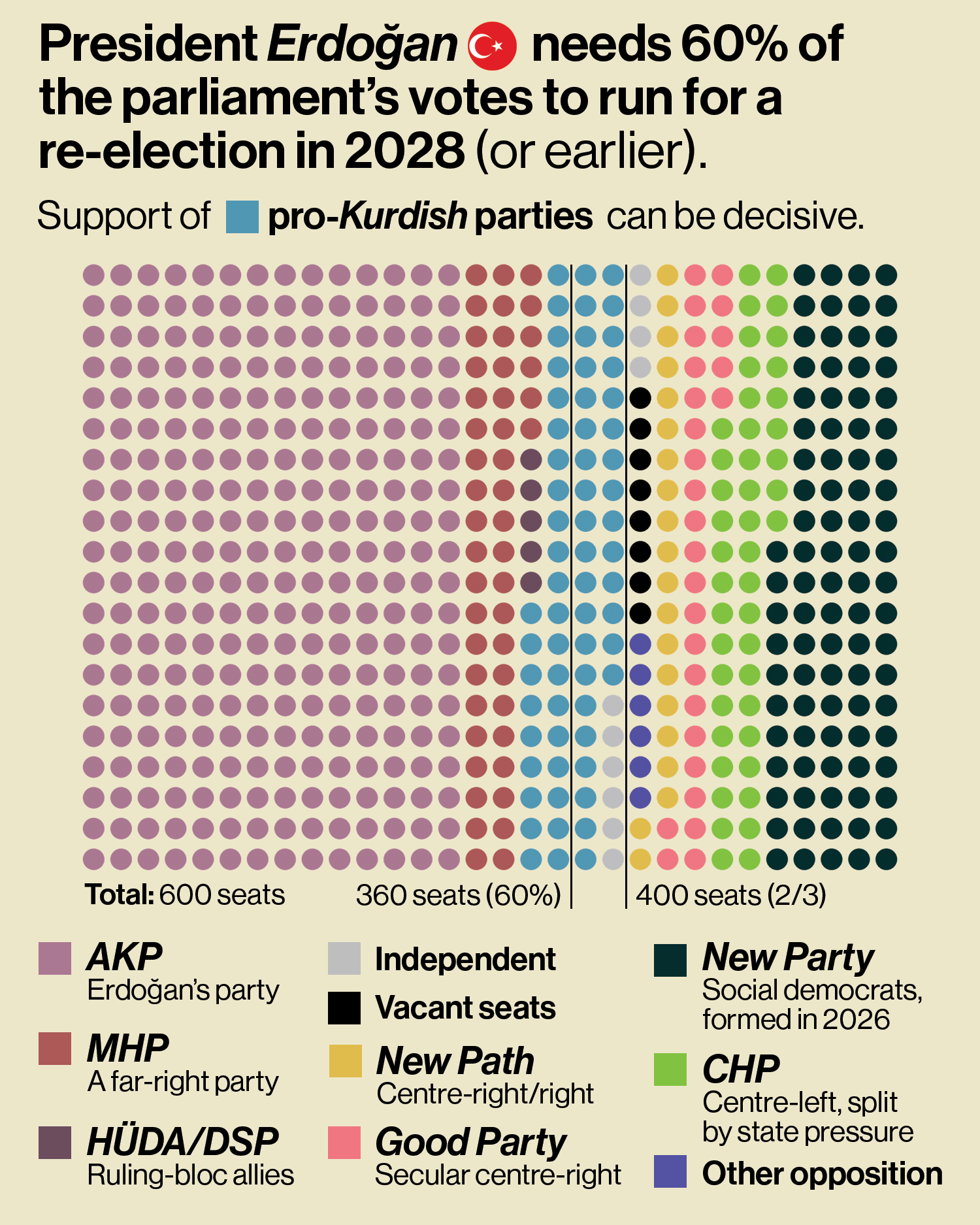
The support of the pro-Kurdish bloc would add 63 votes.
360 votes can also be reached with the support of some independent candidates or members of centre-right parties.
Polls show that 65% of Turks would reject a constitutional change to allow another Erdogan term.
However, opinions are split equally when the question asks about a general constitutional change.
Erdogan denies planning another run and says the election will be held as planned, in May 2028.
He did assign 10 experts to prepare a draft constitution, with no documents shared with the public yet.
- Erdogan’s chief of legal policies said that a large-scale remake of the constitution would be put to the referendum even with 400+ votes.
The pro-Kurdish bloc has not promised its votes, asking first for the release of Kurdish political prisoners and legal protections.
The deal, and disarmament so far
No public agreement was formalised or announced, and Erdogan denies making a deal.
- Some of Erdogan’s nationalist allies are disappointed by the potential deal to pardon Kurdish fighters, especially those connected to war veterans or the military.
- The Kurdish side focused on the release of Ocalan, security guarantees for disarming fighters and the release of prisoners, as well as legal reforms over language and autonomy.
In July 2025, around 30 fighters burned their weapons in northern Iraq, and in October the PKK said it was moving all forces out of Türkiye.
- The group’s Iranian offshoot refused to disarm.
In August 2026, the parliament passed a reintegration law by 468 votes to 88: it pauses trials and sentences for some PKK-related offences for 5 or 10 years.
Its protections apply only once state security agencies confirm full disarmament, with a monitoring board under the vice president overseeing the process.
The sentences of Ocalan and other top leaders are excluded, so they remain in prison.
The militants must also return to Türkiye within 6 months to be part of the process.
This is supposed to be a “framework law” with additions to follow, which the Kurdish side demands as a condition for full disarmament.
As of September 2026, the state had not yet confirmed the PKK’s disarmament as complete.
Erdogan’s main rival has been jailed since March 2025, and the top opposition party split under government pressure, with 91 MPs forming the New Party, now the 2nd-largest.
Thank you for reading!
Keep exploring:


